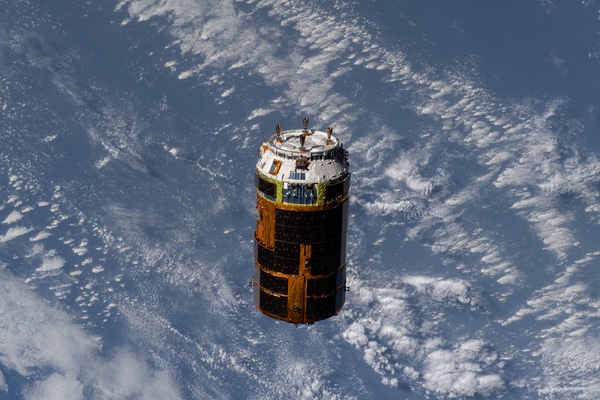
 A Japanese HTV cargo spacecraft departing the International Space Station, an example of the capabilities Japan has developed that could support future human exploration programs. (credit: NASA) |
Raising the flag on the Moon and Mars: future human space exploration in Japan (part 1)
by Makusu Tsuizaki
Monday, May 2, 2022

Japan has progressed in the development and utilization of space over the past 50 years. During this time, space activity has grown from academic research and technology interests to civil and industrial interests. The Japan Aerospace Exploration Agency (JAXA) has been the single national organization for aerospace and space research, technology development, and performing launch of satellites, resulting from the 2003 merger of three previously independent organizations. In addition, the structure of government work for space policy has been changed and the Space Basic Plan was built as a “whole of government” approach. The Cabinet Office (CAO), created in 2012, has functioned to coordinate organizations across the relevant ministries and agencies related to space activities and manage some special committees composed of experts in space as a secretariat office. Through discussions in these committees, finally, the cabinet, consisting of all ministers with relevant roles, decides space policy.
| There is little clear policy and strategy inclusive in human exploration as a whole-of-government matter. |
The Space Basic Plan (main text and implementation plan), a comprehensive governmental space policy and strategy, has been revised periodically since the passage of the Space Basic Law in 2008, and the implementation plan has been revised almost every year recently. Current Prime Minister Kishida stated, “Space is a frontier that gives people dreams and hopes, and is also an important foundation that supports the economy and society from the perspective of economic security.” The latest revised Space Basic Plan makes several substantial points with respect to constellations of small satellites, research and development of optical satellite communications, promotion of the Artemis program, further development of space solar power generation, and international cooperation with the United States, Australia, and India (CAO, 2021).
Human space exploration in Japan began with the commitment to construction of the International Space Station (ISS) and operation (ISS IGA and ISS MOU, 1988) and has been a continuous part of international cooperation since then. In 2020, Japan signed the Artemis Accords with other cooperative countries and is collaborating with the Artemis program led by the United States, targeting the Moon, Mars, and other celestial bodies (The Artemis Accords, 2020). Japan just has started the selection for new astronauts for the ISS and next lunar exploration activities based on participation in the Artemis program.
Although the latest revised Space Basic Plan and some documents written by the Cabinet, the CAO, and the Ministry of Education, Culture, Sports, Science and Technology (MEXT) showed the strategic directions for the ISS, Moon, and Mars exploration in each standpoint, there is little clear policy and strategy inclusive in human exploration as a whole-of-government matter.
In an independent study, the author examined the motives and advantages of human space exploration in Japan and suggested an approach for future policy decision-making. Current Japanese policy is summarized in Table 1.
Table 1: The directions of the ISS, Moon, and Mars exploration in recent policy documents in Japan
| ISS (and LEO) | *ISS would be a testbed of technological development for outer space exploration and should be shifted to industrial utilization and management. *Government should indicate the vision for the ISS and LEO related to international space exploration and induce “seamless” transition for commercial utilization. (MEXT, 2021) *Government should continuously discuss actions in the ISS and LEO after year 2025 with the understanding commercial participation capability and utilization of the ISS. (Space Basic Plan, implementation plan, 2021) |
| Moon | *Government should commit to the Artemis program based on the agreement with the United States, progress the Gateway program, and crewed pressurized rover or basic technologies cooperated with industry for continuous lunar activities. *Japan should aim for the first Japanese landing on the Moon in the latter half of 202’s. (Space Basic Plan, implementation plan, 2021) |
| Mars | With a perspective for future exploration of Mars, which is a goal of the Artemis program, government should progress exploration plans for the main planet of Mars, which will be tackled through international cooperation based on its importance in space science. (Space Basic Plan, implementation plan, 2021) |
| Astronauts | New crews are applied and selected for lunar exploration activities based on participation to the Artemis program. (Space Basic Plan, implementation plan, 2021) |
The advantages of progressing human space exploration in Japan
Japan has committed to international cooperation by sharing the common system operation costs and operating their original experimental module Kibo on the ISS and deciding to participate in the Artemis program. In the case of the ISS, the duration and order of astronaut crews are decided based on the contributions of each participant. Thanks to previous contributions by Japanese astronauts, forthcoming Japanese astronauts continuously play a pivotal role in ISS development and utilization and Japan has a major presence in international exploration projects. Therefore, the most visible benefit of human spaceflight should be that Japanese astronauts continue to be active in outer space, on the Moon, and Mars in the future.
In past activities, Japan has coordinated and encouraged cooperation with the United States, Canada, Russia, Europe, and other Asian countries. In addition to the ISS IGA, Japan has supported developing countries through a trial of new satellite experiments in the ISS, such as the “Kibo-Cube” program. These ongoing collaborations with many countries in the ISS will lead to future space exploration activities with international cooperation and keep a stable relationship between cooperative countries.
From some public viewpoints, the government should advance new technology and industrial development through space exploration. Japan has strengthened its technology base through participation in the ISS and original national projects (Table 2). Cutting-edge basic technologies for future space exploration, such as in-situ resource utilization or data sharing, have been developed in numerous countries and private companies all over the world. International cooperation and sharing of information takes advantage of each country’s strengths while working toward a common goal. As a result, it is possible to gain new knowledge and demonstrate technologies for future human space exploration between cooperating countries. In addition, scientific planetary research has sought to find knowledge of the nature of life. Since robotic exploration technologies for science missions, such as sample return or data collection from other planets, are closely related to future human missions, they will help promote human space exploration.
| How should Japan’s space policy balance international cooperation and the creation of autonomous national capabilities? |
These potential benefits would, in common, encourage stakeholders in space and increase national interest in Japan as well as international awareness. At the same time, these benefits will not be achieved without international cooperation because Japan does not have at least one of the essential technologies for human spaceflight: human-rated space launch vehicles. Such lack of independence in human space exploration comes with various risks, limitations on exploration activities with international commitments or legally binding agreements, and unstable economic or political situations in cooperating countries.
According to recent government policy documents, Japan has promoted human space exploration in international cooperation as much as possible from the viewpoint of cost-effectiveness. These documents also said that it is necessary to continue to acquire, accumulate, and prepare human space technologies centering on key technologies. Doing so will enable Japan to proceed with meaningful efforts in international cooperation that are self-sustaining and cost-effective for future crewed activities (MEXT, 2020).
How should Japan’s space policy balance international cooperation and the creation of autonomous national capabilities?
Table 2: Strong elements and key technologies regarding space exploration in Japan
| Strong elements | National projects (operation period) | Related key technologies |
|---|---|---|
| Human settlement | *ISS (1988-) *Gateway in the Artemis program (2019-) | *robotics *new material usage (space suits, batteries, etc.) *food supply*optical communication |
| Material supply to basecamp | *HTV (1997-2021) *HTV-X (2022-) | *cargo transportation *docking equipment and system |
| Landing on Moon | *SLIM (2022) | *small and light machinery *scanning technology in high resolution |
| Mobility on Moon | *LUPEX (2023) *pressurized rover development (2018- in progress) | *battery *automatic operation *navigation and communication system |
| Sample return from outer planet | *Hayabusa and Hayabusa 2 (2003-) *MMX (2024) *I-MIM (2026) | unique satellite bus and sensor |
Notes: Each project or program regarding space exploration was categorized in line with “Strong elements” shown in the government documents in this table. “Related key technologies” was shown based on each project or program outline referred in public. Note that there are also small-scale R&D that is not project-based (not shown in this table). These technological priorities were shown in a recent government document from the CAO: Deep space supply (rendezvous docking), manned space settlement (environment control), take-off and landing on gravity celestial body (high-precision navigation), surface exploration (surface movement, drilling, water, and ice analysis) (CAO, 2019)
Abbreviations: HTV (H-II Transfer Vehicle), SLIM (Smart Lander for Investigating Moon), LUPEX (Lunar Polar Exploration Mission), MMX (Martian Moons eXploration), I-MIM (International Mars Ice Mapper).
The best balance between international cooperation and independent implementation for Japan
As in the US-led Artemis program, it is necessary for the achievement of human Moon and Mars exploration to develop key technologies and build some advanced and essential facilities for launch, transportation, landing, mobility, and habitat systems in outer space (NASA, 2020).
Japan has been contributing to the ISS for more than 30 years and developing some key technologies and knowledge essential to human settlement. In addition, Japan has also decided to commit to the Joint Exploration Declaration of Intent for Lunar Cooperation (JEDI), Artemis Accords and Gateway MOU between the United States, and progressing on some programs with international collaboration (Table 2).
In terms of policymaking in Japan, the author would argue that government budgets and international cooperation are the most significant considerations.
Government budgets
To manage human space exploration, there are at least four conditions to consider given the current situation in Japan: 1) the budget allocation balance between ISS, Moon, and Mars projects, 2) the balance between human spaceflight and robotic space planetary science in JAXA, 3) MEXT/JAXA budget and other ministries’ and agencies’ budgets, 4) the priority between international cooperation and national security.
1) The budget allocation balance between ISS, Moon, and Mars projects
The profile of the recent seven years (FY2015–2021) budget of the ISS, Moon, and Mars projects is shown in Fig. 1. Reflecting on the declaration for participation in the Artemis program in 2019 and the assignment of the Artemis Accords in 2020, all human exploration-related budgets and the JAXA total budget were larger in FY2020 and FY2021 than the former years. The ratio of the former years’ budget was 114% and 105% (JAXA total budget), and 136% and 117% (human exploration budget), in FY2020 and FY2021, respectively. One thing worth mentioning is that the ISS budget has included HTV or HTV-X, a unique material supply vehicle for the ISS, which also will be used for supply for the Gateway construction and operation is strongly linked to the Moon budget.
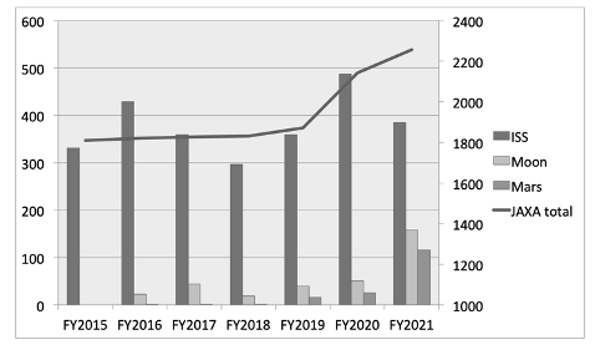 Figure 1 Human space exploration budget as of FY2021 in Japan. The budget amount for each year was the sum of the original budget and the previous year’s supplementary budget. The right side scale was for JAXA total budget (unit: 100 million Yen), and the left side scale was for ISS, Moon, and Mars projects or programs (unit: 100 million Yen). Each category included the following budget of projects or programs; JEM (Japanese Experiment Module) operation spending (FY2015-FY2021), HTV (FY2015-FY2020), and HTV-X (FY2016-FY2021) in “ISS”; SLIM (FY2016-FY2021), pressure rover development (FY2018-FY2021), contribution to the Gateway (FY2019-FY2021), and LUPEX (FY2020-FY2021) in “Moon”; MMX (FY2016-FY2021) in “Mars” |
As of now, almost all spending on projects for the ISS, Moon, and Mars have been provided to JAXA through MEXT. The ISS is scheduled to be sustained through 2024 and could be extended to 2030. It has been mentioned that NASA would allow one or more commercial firms to own its share of the ISS or a LEO station in the future, at least from 2028. The ISS operation in the future is pending, however, it would be unrealistic for Japan to proceed with Moon and Mars exploration while operating the ISS at current costs. Under the international agreement, Japan might keep governmental responsibility for only critical contributions for sustaining the ISS.
| There is not enough funding for future long-term human space exploration with only the current MEXT/JAXA budget. |
With regards to the balance of JAXA’s budget, it could be affordable to focus on development and utilization of the Gateway or basic leading technologies for future human space exploration, and then a financial shift to Moon and Mars exploration. In recent years, JAXA has developed more potential research projects such as basic space exploration technology in a wide range of unexplored areas such as automatic and autonomous technology, and also named a “innovation hub for space exploration” program. It is effective to develop unique technologies from these programs into larger future projects.
2) The balance between human spaceflight and robotic space planetary science
How to keep the balance between human spaceflight and space science has been discussed earlier (Takashi Uchino, 2019) and some programs for international collaboration are intended to include both civil and scientific perspectives. Generally speaking, space science missions are often small-scale at first and require longer-term research. For this reason, a certain amount of budget has been set aside in the JAXA budget for space planetary science. While lunar exploration is focused on human activities, Mars exploration currently emphasizes robotic scientific activities. Basic scientific research findings and development will promote technological progress for another space program in many cases. For example, the Japanese-leading international Mars exploration project, MMX (Martian Moons eXploration), targets not only the exploration of the satellites of Mars but also the measurement of environmental radiation in the outer planets, which contributes to human settlement technology. To establish the goal of Mars human exploration, it is suggested to keep a continuous discussion with the science community and build advanced programs in the future.
3) MEXT/JAXA budget and other ministries’ and agencies’ budgets
There is not enough funding for future long-term human space exploration with only the current MEXT/JAXA budget, according to the author’s understanding from MEXT and JAXA. In Japan, the CAO was built in 2012 as the new organizational structure to be in charge of space policy. At present, in addition to the MEXT, the Ministry of Economy, Trade and Industry (METI) and the Ministry of Internal Affairs and Communications (MIC) can also support JAXA, and all ministers could commit to decisions of national space policy. As a result of the implementation of a comprehensive national space policy, more Ministries and Agencies have committed to support the Japanese space program. In recent years, for example, the MIC has committed to the development of positioning and communication technology for lunar activities, and the Ministry of Agriculture, Forestry and Fisheries (MAFF) has started the development of an advanced resource-circulating food supply system to support long-term stays on the Moon. Given the need for more ministries and agencies to be involved in space exploration, it is expected the CAO lead a stronger initiative for overall progress in this field. This will be discussed in part two.
4) The priority between international cooperation and national security
National security is one of the most important areas of space policy in Japan today, including the construction of satellite constellations and space situational awareness (SSA) through international cooperation as in other countries. Many countries have been expanding their activities in outer space and it is necessary to consider space exploration efforts that are not necessarily directly related to their national security but are nonetheless tied together.
For example, sharing information with other countries about planetary exploration will lead to safer activities for astronauts on those planets. Also, cases such as lunar resource utilization or operations by astronauts’ activity on the Moon remind us to consider who has the rights to use resources in outer space or who should exercise jurisdiction over astronauts. Although it is legally required in the Outer Space Treaty and the Artemis Accords that space exploration be only for peaceful purposes, some states might insist on their right to utilize and dominate outer space in the future. This topic has been part of various arguments for outer space regulation in bilateral and multilateral forums.
In addition, in Japan, the new minister in charge of economic security (including national security perspectives) has been named in 2021 for the first time, Takayuki Kobayashi, and he is also engaged in science and technology policy inclusive of space policy. This political situation suggests a deeper connection between national security and science and technology policy in Japan. Under these circumstances, it is important to consider how human space exploration contributes and affects to enhance national security. These perspectives should not be thought of as trade-offs but as correlations for mutual understanding, as will be discussed later.
References
The CAO, Space Basic Plan, summary of revision and revised implementation plan (2021), (in Japanese)
ISS IGA (1988): Agreement Among The Government Of Canada, Governments Of Member States Of The European Space Agency, The Government Of Japan The Government Of The Russian Federation, And The Government Of The United States Of America
ISS MOU (1988): Memorandum Of Understanding Between The National Aeronautics And Space Administration Of The United States Of America And The Government Of Japan Concerning Cooperation On The Civil International Space Station
The Artemis Accords (2020)
The MEXT, What the ISS or LEO should be? (Interim report)(2021), (in Japanese)
The MEXT, Human space exploration in Japan (2020), (in Japanese)
The CAO, Japan's Participation Policy in International Space Exploration Proposed by the United States (2019), (in Japanese)
NASA, Artemis Plan, NASA’s Lunar Exploration Program Overview (2020)
Takashi Uchino, “What should be Japan’s strategy for human space exploration?”, The Space Review (2019)
International Thermonuclear Experimental Reactor (ITER) Agreement (2007)
Masaki Takata and Wataru Utsumi, The Next Generation 3GeV Synchrotron Radiation Facility Project in Japan, Facts and info from the European Physical Society (2019)
ESA, Terrae Novae 2030+ Strategy Roadmap (2021)
Takuya Wakimoto, A Guide to Japan’s Space Policy Formulation: Structures, Roles and Strategies of Ministries and Agencies for Space, Pacific Forum Working Paper (2019)
National Space Council, A New Era for Deep Space Exploration and Development (2020)
Takashi Uchino, A comparison of American and Japanese space policy structures, The Space Review (2018)
STIG (Science, Technology, and Innovation Governance) Education and Research Program, The University of Tokyo, The Future of Lunar and Cislunar Activities: Commercial, Governance & Security Challenges (2022)
European Space Policy Institute (ESPI), New Space in Asia (2021)
CNSP, Space Industry Vision for 2030 (2017), (in Japanese)
Walter Peeters, Evolution of the Space Economy: Government Space to Commercial Space and New Space, Astropolitics (2022)
Jeff Foust, “Japan passes space resources law,” Space News (2021)
Note: we are using a new commenting system, which may require you to create a new account.
