Friday, March 3, 2023

Thursday, March 2, 2023
Three Rules FOr Peace In Orbit
Three rules for peace in orbit in the new space era
by Brian G. Chow and Brandon W. Kelley
Monday, February 27, 2023

The United States and its partners clearly recognize the need for a space traffic management (STM) regime capable of managing 21st-century space security challenges. Expectations are high ahead of the United Nations Summit of the Future in September 2024. Policymakers and diplomats are hard at work preparing the ground, partly via unilateral policy changes but also through sessions of the Open-Ended Working Group (OEWG) and the upcoming preparatory ministerial meeting this September.
Despite these aspirations, there remains a real risk of failure. Countries may fail to reach sufficiently widespread agreement on a short enough timescale to defuse the growing threats. Worse, countries could agree to and implement an STM regime actively harmful to the security and/or economic interests of those who join it.
| Worse, countries could agree to and implement an STM regime actively harmful to the security and/or economic interests of those who join it. |
Fortunately, the US can prevent both outcomes. To do so, the US must adhere to three rules in its approach to STM. First, the STM system must be “bad actor”-proofed. Second, the regime must provide timely warning and defense. Third, the STM regime must be structured in such a way as to align all parties’ incentives toward agreement and compliance. By building these three rules into STM design and negotiations from the outset, the US and its allies can establish a strong foundation for continued peace and prosperity in orbit.
A framework for effective STM
It is the policy of this administration, as articulated in the most recent National Security Strategy (October 12, 2022), that,
America will maintain our position as the world’s leader in space and work alongside the international community to ensure the domain’s sustainability, safety, stability, and security. We must lead in updating outer space governance, establishing a space traffic coordination [STC] system and charting a path for future space norms and arms control.
For such a system to be effective (note: this article uses the term STC interchangeably with STM), it must be built on three core principles. These criteria will enable the regime to balance peace, security, and stability on the one hand, with prosperity, sustainability, and safety on the other.
The first rule is that the US must refuse to join any STM system which is not adequately “bad actor”-proofed. The US and its partners should firmly establish and declare as a non-negotiable precondition that they will accept no STM system consisting of any rule(s)—or lack thereof—vulnerable to exploitation by bad actors. The STM regime adopted must not reward or incentivize aggression, but must also not sidestep the need to address key threats to space security. There are particularly strong reasons to believe that China and Russia, if not denied the opportunity via an adequate STM regime, will seek to exploit various space governance lacunae in the coming years. For example, there are concerns that they could seek to hold many critical US satellites at risk by as early as 2026, with dangerously destabilizing results.
The second rule is that the STM regime must ensure timely warning and defense. This requires first that abstract concepts of responsible behavior be translated into concrete rules of the road for space that are transparent, verifiable, and enforceable. Second, those rules must be deliberately designed to favor the defense, including maximizing warning time and facilitating adequate response measures. This will prove especially critical during a crisis or in the early stages of an incipient military conflict, during which ambiguity is especially dangerous.
| The current approach to STM focuses almost exclusively on space sustainability… The result is that insufficient attention is being paid to counterspace threats. |
The third rule is that both the US negotiating strategy and the STM regime itself must be designed to actively incentivize agreement and continued compliance. The US and its allies have many carrots and sticks at their disposal to induce consensus and to deter and punish defection, and should make full and creative use of these. As one example, the US and its allies can and should condition continued access to lucrative Western space markets on assent and adherence to STM rules such as norms of responsible behavior and limits on close approaches to critical assets. Doing so could significantly alter the incentive structure of various nations, most importantly Russia and China. A second example is that the US should publicly elaborate its understanding of relevant international legal rules, and especially of what means of retorsion are lawfully available to states to “encourage” a return to compliance with such rules. This would make clear that rogue actors should expect to pay steep costs for little reward, making defection and cheating much less attractive options than they will otherwise be.
How does the current US approach stack up against these rules, and what changes are required?
Applying rule 1: “bad actor-proofing” the STM regime
The current approach to STM focuses almost exclusively on space sustainability. Moreover, measures currently being pursued are almost exclusively voluntary, and the current process is limited primarily to traditional decision-by-consensus international fora.
The result is that insufficient attention is being paid to counterspace threats, which is likely to have serious consequences for national security. Given the option, Russia and China will ensure that any consensus which does emerge is pure theater, failing to deal with the most significant real threats. One example, covered at length previously, is that current STM proposals will likely do very little to prevent or deter potential adversaries’ dual-use “R-spacecraft”, capable of rendezvous and proximity operations (RPO), from prepositioning very close to critical but vulnerable strategic military, intelligence, and navigational assets housed in geosynchronous, highly elliptical, and medium Earth orbits during this decade and well into the 2030s. There are other threat vectors, of varying severity and timeline. By establishing as a necessary precondition for agreement on any STM regime that the STM system must meaningfully limit such harmful and destabilizing behaviors, the US and its partners can avoid unwittingly creating a hollow orbital regime—or, worse, tying their own hands.
Applying rule 2: ensuring “timely warning and defense”
There is growing awareness that passive defenses, such as proliferated architectures, are necessary but insufficient to deal with a myriad of emerging new challenges to peace and sustainability in orbit. Instead, these must be countered by clear rules established ex ante to enable monitoring, attribution, timely warning, and effective defenses, in order to deter hostile behavior, and facilitate strong but de-escalatory responses in a crisis should deterrence fail.
Unfortunately, this growing recognition has, with limited exceptions, not yet translated from abstract principles to actionable rules of the road. For example, the Biden Administration’s Defense Department has publicly emphasized various principles that should govern on-orbit operations, including safe separation, an approach consistent with international negotiations that have heretofore remained similarly broad. This accrues to the interest of potential adversaries: for example, the Chinese delegate to the current OEWG on space security insisted that “the use of particular capability or technology in particular circumstances” is “not appropriate to be discussed in the OEWG.” However, such a capabilities- and situations-focused approach is exactly what is required.
The US must begin by systematically identifying what rulesets would facilitate successful monitoring and attribution and provide adequate warning and an advantage to the defense. The US must then publicly establish clear, stabilizing limits in line with these needs, and elaborate the contours and international legal bases for such rules—jointly with allies if possible, and unilaterally if not.
There are many options for what form this might take. For over 30 years, various authors have forwarded different proposals for how to safely regulate on-orbit activity, including self-defense zones, safety zones, keep-out spheres, and warning/self-defense zones. While these proposals vary significantly in their provenance and details, they all share one central analytic insight: the pressing need for a framework disincentivizing and countering dangerous behavior on-orbit, and especially shielding the highest-value assets from harm. This is critical, not only because of preserving capabilities of the vulnerable satellites themselves but because of removing dangerously destabilizing pressures for first-use—or for threats thereof—that such vulnerability may otherwise create.
| The US cannot afford to adopt an approach to STM predicated on some assumption of shared values, mutual interest, or global community. Instead, the approach must always be grounded in a clear-eyed assessment of every player’s incentives. |
Now is a unique opportunity to establish such a framework. Developments over the past few years, including the Artemis Accords’ use of safety zones and discussions of CONFERS, have lent additional credence to this concept. In December 2022, US Space Force (USSF) issued the Space Doctrine Publication 4-0 Sustainment, Doctrine for Space Forces, which “articulates extant best practices and lessons learned for sustainment of space forces.” It refers to RPO and docking as “prerequisite enabling capabilities,” and notes that “proximity operations commence when a visiting vehicle enters the keep-out sphere established for the target vehicle.” This reference to keep-out spheres as a best-practice for governing on-orbit support of space operations is promising, but in order to shape other countries’ behavior, as well as to minimize the potential for undue escalation, it must be supported by public elaboration of the rules. Establishment of these STM rules will, in turn, give rise to additional needs for doctrinal revision and procurement: a system of “keep-out spheres” will require the capabilities and procedures necessary to monitor and enforce said spheres.
In particular, the United States should develop and deploy small and cheap bodyguard spacecraft, optimized for cost-effective defense against R-spacecraft and with similar capabilities, to enable persistent monitoring and enforcement of the “zones” surrounding high-value assets. These bodyguards can be designed to have non-destructive measures onboard to deal with low-level incursions in non-escalatory ways. For example, a bodyguard can escort an invader out of the zone, or catch it and maneuver it outside the zone for release, or use reversible and non-debris-producing means to disable it. That said, more forceful measures—whether direct or cross-domain—should remain available, in case their use should become necessary and legally justified.
Applying rule 3: “incentivizing agreement and compliance”
Finally, while the current efforts to generate international consensus are admirable, they are often insufficiently attentive to the differing incentive structures of various actors, especially potential adversaries.
Key decisionmakers in Moscow and Beijing have interests clearly orthogonal to those of the US and its allies. Russia’s illegal and horrific invasion of Ukraine, as well as their wantonly destructive direct-ascent anti-satellite (DA-ASAT) test, should dispel any lingering doubt on this point. China’s tacit acceptance of the Ukraine invasion, as well as their treatment of the Uyghurs, open intent to seize Taiwan against its will, and countless other examples, further underscore the degree to which these autocracies have core national interests inescapably in conflict with those of the United States. As President Biden openly acknowledged in September 2022 before the UN General Assembly, contrary interests have routinely lead both countries to play spoiler in international negotiations, weaponizing their ability to single-handedly frustrate consensus. The space domain is no exception.
For this reason, the US cannot afford to adopt an approach to STM predicated on some assumption of shared values, mutual interest, or global community. Instead, the approach must always be grounded in a clear-eyed assessment of every player’s incentives. The US and its allies must do everything in their power to incentivize potential spoilers to agree to, and remain in ongoing compliance with, a well-designed STM regime. We must be cognizant that the perceived benefits of refusal—or of initial agreement followed by noncompliance, whether overt or covert—are likely to be quite high for potential rogue actors. Thus, wherever possible, these benefits must be attenuated, and substantial associated costs established and their imposition made as certain and credible as possible.
One promising example of such an incentives-focused approach would be for the United States and its allies to leverage conditional access to Western space markets as a carrot for agreement to and compliance with an STM system (reference 1 and reference 2). Such a regime may include a variety of provisions aligning with the declared tenets by the US of responsible behavior in space, but must at least include limits on en masse pre-positioning near vulnerable critical satellites.
| One promising example of such an incentives-focused approach would be for the United States and its allies to leverage conditional access to Western space markets as a carrot for agreement to and compliance with an STM system. |
This would not be a leap: indeed, US market access is already conditioned on compliance with various US rules and regulations. As recently as September 2022, the Federal Communications Commission (FCC) officially adopted a new order requiring that the operators of satellites ending their missions in or passing through low Earth orbit dispose of their spacecraft via re-entry into Earth’s atmosphere within no more than five years of mission completion—a rule that applies not only to satellites licensed in the United States, but also to those licensed elsewhere and seeking US market access.
In this way, and others, the US can attach benefits to agreement, attenuate the upsides of noncompliance, and sharply increase the costs of cheating or defection. This is likely to influence other countries’ calculations, especially those of Russia and China. This may produce agreement and compliance, as they decide that the benefits of joining far outweigh the associated costs.
Alternatively, should they refuse to join, the fact of having to forego substantial benefits in order to do so will be impactful. First, it holds great normative significance for the international system. Second, because the mere act of opting out despite the clear economic benefits would signal that these countries have a strong preference for retaining the ability to freely conduct hostile ASAT actions, which in turn would bolster the legitimacy of protective actions and efforts to enforce the Western STM regime’s rules. Finally, even if they refuse to join, this framework, especially equipped with timely warning and defense, would heavily limit their ability to conduct hostile or unsafe on-orbit operations.
Conclusion
The United States is standing at the precipice of a new era in space security. The Biden Administration faces an historic opportunity to build an STM regime well-suited to the new space age. To make the most of this opportunity, however, the US will have to update its approach. By adopting the three key recommendations above—refusing to agree to any STM rules vulnerable to exploitation by bad actors, adopting timely warning and defensive advantage as core design principles, and proactively employing carrots and sticks to shape the incentive structures of relevant parties—the US can help to ensure peace and prosperity in the 21st century, and head off dangerously destabilizing pathways to great power escalation.
Note: we are using a new commenting system, which may require you to create a new account.
Some New Rockets Appear This SPring
New rockets spring to lifeby Jeff Foust |

| The countdown ticked down to the final seconds and the L-9 engine ignited… only to shut down seconds later, before the ignition of its solid-fuel strap-on boosters. |
The first H3 launch slipped from 2020 because of various delays, primarily involving the L-9 engine that powers its first stage. Finally, though, the rocket was ready to launch from the Tanegashima Space Center on the morning of February 17 (evening of February 16 in North America.)
The countdown ticked down to the final seconds and the L-9 engine ignited… only to shut down seconds later, before the ignition of its solid-fuel strap-on boosters. JAXA later stated that ignition signals to the boosters were not sent and the L-9 engine shut down, apparently because of an electronics glitch.
As of late February, there had been no official updates on the status of the inaugural launch, carrying the ALOS-3 Earth science satellite, other than a goal to carry out the launch no later than March 10. When it does fly, there is a backlog of primarily Japanese government missions awaiting the H3, including reconnaissance satellites and cargo missions to the International Space Station. There has been, though, little commercial interest in the H3 so far despite its lower cost, which remains high compared to competitors like SpaceX’s Falcon 9.
A 3D-printed rocket
In Florida, Relativity Space is preparing for the first launch of its Terran 1 rocket from Cape Canaveral’s Launch Complex 16. The small launch vehicle, designed to place up to 1,250 kilograms into low Earth orbit, stands out in a crowded field for two key technologies. The rocket is primarily manufactured using 3D-printing technologies: Relativity has developed: about 85% of the rocket’s mass was manufactured that way. It also uses methane fuel along with liquid oxygen; if it reaches orbit on its inaugural launch it will be the first “methalox” rocket worldwide to do so.
But there are no guarantees that Terran 1 will reach orbit on its first launch, given the track record of such debuts: ABL Space Systems suffered a failure of its first RS1 rocket, similar in performance to Terran 1, last month (see “Too many or two few? The launch industry’s conundrum”, The Space Review, February 13, 2023). Relativity has embraced that: the inaugural launch carries no customer payloads and it calls the mission “Good Luck, Have Fun.”
The company announced last week it set a date for Good Luck, Have Fun: March 8, in a three-hour window that opens at 1 pm EST. That launch will be the culmination of a campaign that has included tests of the company’s Aeon 1 engines and the two stages of the rocket.
| “It’s been a truly wild ride to get to this point, and certainly way harder than I ever imagined going into it – but all the feels from me and our team as we embark on this historic launch,” Ellis said. |
It will not, though, include a static-fire test of the first stage of the full vehicle on the pad as previously planned. A company spokesperson said the company had concluded it has reduced enough risk from those earlier tests that the additional benefits of a full vehicle static fire did not outweigh the additional wear and tear on the vehicle ahead of a first launch attempt. The spokesperson added that meant an additional chance of an abort on their first launch attempt, but if the vehicle was ready, it was time to launch it and see what happens rather than simply do a static fire.
The company is eager, perhaps to finally launch Terran 1 so it can move on to bigger things. The company announced in 2021 plans for a much larger rocket, Terran R, that would be fully reusable. It will use some of the same 3D-printing and methalox engine technologies as the smaller Terran 1, but in a vehicle with perhaps more potential commercial and government business.
Tim Ellis, the CEO and co-founder of Relativity Space, said he was ready for the launch. “It’s been a truly wild ride to get to this point, and certainly way harder than I ever imagined going into it – but all the feels from me and our team as we embark on this historic launch,” he tweeted.
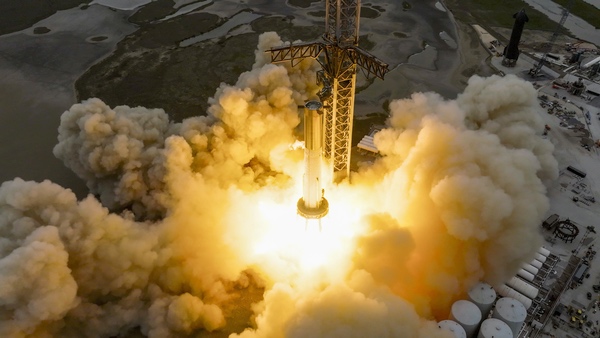 After a static-fire test earlier in the month, SpaceX is moving ahead with a first Starship launch as soon as March. (credit: SpaceX) |
Starship: “light ’em up and go”
Attention will soon turn, though, to a much larger rocket: SpaceX’s Starship. The company performed a static fire of nearly all the 33 engines in the vehicle’s Super Heavy booster February 9 at its Starbase facility in Boca Chica, Texas. (One engine was shut down before the test and a second shut down early, but SpaceX CEO Elon Musk declared it a success.)
The day before the test, SpaceX President Gwynne Shotwell said that static fire would be the final milestone before launch. “It’s really the final ground test that we can do before we light ’em up and go,” she said at the FAA Commercial Space Transportation Conference in Washington. “That first flight test is going to be really exciting. It’s going to happen in the next month or so.”
In the days after the test, there was speculation SpaceX might want to do another static fire since only 31 of 33 engines worked as planned. But at the Space Mobility conference last week in Orlando, another company official said SpaceX was moving ahead with an orbital launch attempt.
“We had a successful hot fire, and that was really the last box to check,” said Gary Henry, SpaceX senior advisor for national security space solutions. “The vehicle is in good shape. The pad is in good shape.”
“Pretty much all of the prerequisites to supporting an orbital demonstration attempt here in the next month or so look good,” he added. SpaceX still needs an FAA launch license, but he predicted the company would get one “in the very near future.” That would set the company up for a launch “probably” in March, he estimated.
| “We had a successful hot fire, and that was really the last box to check,” said Henry. “The vehicle is in good shape. The pad is in good shape.” |
Henry said that Starship launches will initially be used primarily for launches of Starlink V2 satellites, which are much larger than the first-generation satellites launched dozens at a time on Falcon 9 rockets. “We have a few that are waiting very patiently to be launched on Starship,” he said of those satellites.
Those launches, and tests of Starship needed to support NASA’s Human Landing System program, will accelerate Starship’s transition into routine operations. “We very, very quickly converge on a system that we can operationalize,” he said.
“We are on the cusp of seeing an opportunity of mass to orbit go from $2,000 a kilogram to $200 a kilogram,” he predicted, adding that, in the long-term, launch costs might come down to the point where the cost of propellants is the major factor in overall launch costs. “If Elon gets his way,” he said, “you’re at $20 per kilogram.”
Among those watching Starship’s development is Jared Isaacman, the billionaire backer of the Polaris Program of private astronaut missions. The third and final Polaris mission will be the first crewed flight of Starship.
Speaking at the SpaceCom conference in Orlando two days after Henry, Isaacman said he was impressed with Starship, saying if it achieves SpaceX’s goals to be fully and rapidly reusable it could be a “gamechanger” for space. At one point he suggested it could be to space what the Boeing 737 jetliner was to aviation; later, he likened it to the Douglas DC-3.
He said, though, he didn’t know when SpaceX would be ready to fly his Polaris mission on Starship. “They have a constellation to build out with the next generation of Starlinks,” along with other satellite customers, he said. Shotwell said earlier in the month she expected at least 100 Starship launches before it carried people for the first time.
 ULA is preparing the first Vulcan Centaur rocket for a launch now scheduled for no earlier than May 4. (credit: ULA) |
A Vulcan on Star Wars Day
United Launch Alliance’s response to the changing launch market and external forces like the loss of access to the Russian RD-180 rocket engine has been the Vulcan rocket, powered by Blue Origin’s BE-4 engine. The first launch of Vulcan, though, has slipped by several years, with engine development a key factor.
Last Thursday, ULA CEO Tory Bruno told reporters that the company now had a date for the first Vulcan Centaur launch: May 4. That schedule, he said, had only recently firmed up, and was based on several factors.
One was testing of the Vulcan at its Cape Canaveral launch site. The vehicle, stacked inside a vertical assembly facility, would soon roll out to the pad for tanking tests and a wet dress rehearsal, where both stages would be fully fueled and go through a practice countdown. That would be followed by a flight readiness firing, where the vehicle is fueled again but this time the BE-4 engines are fired at 70% of their rated thrust for 3.5 seconds.
Bruno said the “pacing item” for the launch was not that series of tests but separate qualification of the BE-4 engines. “It’s taking a little bit longer than anticipated,” he said.
| “I have a backup plan for everything, including my backup plans,” Bruno said. |
Engineers ran into an issue with one of two engines going through those final qualification tests where the engine’s main oxygen pump had a performance about 5% higher than what had been seen on other BE-4 engines. Higher performance might not seem like a bad thing, but he said it could be a sign of trouble elsewhere with the engine.
“When the performance of your hardware has even a small shift that you didn’t expect, sometimes that is telling us that there could be something else going on in the system that is potentially of greater concern,” he warned.
After dissembling the engine, ULA and Blue Origin determined that its performance was only unit-to-unit variation among engines, something Bruno said he has seen among other rocket engines. Those qualification tests are continuing and should be completed in about six weeks.
That would allow Vulcan to be ready for launch by mid-April, he said. However, the primary payload for the inaugural Vulcan launch, Astrobotic’s Peregrine lunar lander, has windows only a few days long each month. The window in April, Bruno said, closed before mid-April, so ULA would have to wait until the next one, which opened May 4 and would run for about four days.
That assumes that Peregrine and other payloads for the launch—a pair of demonstration satellites for Amazon’s Project Kuiper broadband constellation and the Enterprise Flight payload from space memorial company Celestis—are ready. Bruno said he was optimistic that would be the case, noting that Peregrine recently completed tests at the Marshall Space Flight Center and was back at the company’s Pittsburgh headquarters for final preparations before being shipped to the Cape.
“I’m not concerned about them,” he said of Astrobotic. “I feel very confident they will be ready to go.” The same confidence, he said, extended to Amazon and Celestis.
He suggested, though, that ULA has contingencies if one of more of the payloads do not arrive when Vulcan is ready to fly. “I have a backup plan for everything, including my backup plans,” he said. “But at this point, I don’t want to go into that because it’s not relevant. Everybody looks like they’re in really good shape.”
That first launch, called Cert-1 by ULA, would be followed later in the year by Cert-2, carrying Sierra Space’s Dream Chaser vehicle. Bruno said he expected ULA to take at least a few months before those two missions, depending on the status of Dream Chaser. That schedule would allow Vulcan to be certified by the Space Force for national security missions, with the first potentially before the end of the year.
Having Vulcan certified will allow ULA to start flying a backlog of national security space missions as well as dozens of launches for Amazon’s Project Kuiper constellation ordered last year. “We have to ramp up,” he said, at least doubling the Vulcan launch rate in 2024. “Before the end of ’25, we expect to be really at a tempo which is flying a couple of times a month, every two weeks.”
That would be a rate far higher than that ULA demonstrated with its Atlas and Delta vehicles, and the company announced investments last year after winning the large Amazon order to support higher production and launch rates. Along with it, he said ULA will prepare for what it calls “SMART reuse” of the Vulcan, which focuses on recovering and reusing the BE-4 engines rather than the entire stage.
“It will take a couple of years to actually be reusing the engines,” he said, including technology demonstrations like the test of an inflatable decelerators flown as a secondary payload on an Atlas 5 launch last fall. “Eventually, we’ll have the confidence to recover them, inspect them, and them reuse them. That will happen in this window of a few years.”
“You’ll see the activity pretty quickly ramp up,” he added, referring to tests of SMART reuse. The same could be said of the broader launch industry, as companies finally get their vehicles to the pad to see which ones can technically work, and which of those can, in turn, survive in the market. For every spring, there is also a fall.
Note: we are using a new commenting system, which may require you to create a new account.
Home
Journey To A Cold And A Dark Moon
Journey to a cold and curious moonby Dwayne A. Day |

 There are two theoretical explanations for Triton's geysers. One theory is that sunlight penetrates clear ice and heats material underneath, resulting in a cryovolcanic explosion. The other is that Triton could have an ocean under the ice and warm water breaks through as geysers. Triton also has an intense ionosphere that puzzles scientists. (credit: Trident team) |
Chaos moon
On September 23, 1846, Neptune was discovered by Johann Galle, and its large moon Triton was spotted a little more than two weeks later by English astronomer William Lassell. Lassell determined that Triton was orbiting in a direction opposite of Neptune’s rotation, the only large moon in the solar system that does this. Since this discovery, scientists have speculated that Triton is a captured object that originated in the Kuiper Belt, a circumstellar disc in the outer solar system extending from the orbit of Neptune at 30 astronomical units (AU) out to approximately 50 AU. An AU is the distance from the Sun to the Earth, making the Kuiper Belt very far out. Pluto is a Kuiper Belt Object, and Triton almost certainly is as well.
| The mission illustrates the science still to be done at the cold edges of our solar system and provides a blueprint for how missions to the edge of the solar system could be conducted on a budget. |
Triton’s capture by Neptune would have substantially heated Triton. Triton is also in a high-inclination orbit compared to Neptune’s equatorial plane, which some scientists have predicted is sufficient to maintain an internal ocean under the moon’s icy surface. But nobody was expecting this in 1989.
When Voyager 2 flew past Triton 143 years after its discovery, it revealed very few craters, indicating that Triton’s surface is relatively young: perhaps 50 million years old, or possibly even less than 10 million years old. This foreshadowed New Horizons’ 2015 encounter with Pluto, which also revealed a surprisingly young surface for a cold world in the outer solar system. Voyager revealed that Triton is dynamic, with various processes resurfacing it, including volcanism, tectonic movement, and sublimation. Voyager also wowed scientists by revealing Triton’s surface to be very diverse, with several different types of terrain, most notably the “cantaloupe” terrain that covers much of its surface—named that because it looks like the skin of a cantaloupe.
The crazy plumes that Voyager found are located on the volatile-rich south polar terrain. The generally accepted theory is that they result from the explosive venting of dark material from beneath transparent ice, but there is no agreement about the exact cause. An early theory was that this was a “solid-state” process whereby sunlight passed through the ice and heated material below it, turning it to gas, building up pressure until it burst through the surface ice. But a more recent theory is that Triton may harbor a subsurface ocean like that on Saturn’s moon Enceladus, which may drive icy volcanic eruptions in the same way. If true, that could have major implications for the search for life in the universe.
These various characteristics mean that Triton is a member of three distinct populations: Kuiper Belt Objects like Pluto, ocean worlds like Ganymede, Titan, Europa and Enceladus, and plume worlds like Europa and Enceladus. Triton could provide useful information for understanding all three populations. There’s also another aspect of Triton that makes it so interesting and odd: it has a surprisingly active ionosphere. For a moon that we would normally expect to be frozen and uninteresting, Triton defies expectations. Scientists want to know why, and several years ago some of them proposed a mission known as Trident to explore it.
 The Trident team proposed a standard suite of instruments for the spacecraft. Unlike the instruments used on the New Horizons mission, these would not have to operate at low power during the flyby. Instead, the spacecraft would carry batteries that would be charged by RTGs. This approach would have kept the instrument cost lower than New Horizons. (credit: Trident team) |
Tiny spacecraft, big journey
“The Trident concept actually came out of a two-day Architecture Team study in 2017, coincidentally not long before the Cassini Grand Finale,” explained Karl Mitchell, of the Jet Propulsion Laboratory and a Project Scientist on the Trident proposal team. “A team of scientists and engineers were brought together at the request of Brent Sherwood and Kim Reh, who were in charge of the JPL Discovery Program portfolio, and asked the question, ‘What new mission concepts would be enabled if the next Discovery call included the option for RTGs?’”
RTGs, or radioisotope thermoelectric generators, are essentially “atomic batteries” powered by plutonium-238, an isotope of the rare element that is not used to make bombs but instead conveniently gives off a substantial amount of heat that can be converted directly into electricity. RTGs can provide power when sunlight is too dim for solar panels, or where mission operations make solar panels hard to use. The Perseverance and Curiosity rovers use a Multi-Mission Radioisotope Thermoelectric Generator (MMRTG). Cassini used RTGs at Saturn and New Horizons needed one to operate near Pluto.
| Prockter said that the mission wasn’t originally named “Trident,” “but we were worried about the copyright implications of calling it ‘Project Hoth.’” |
JPL looked into what they might do with RTGs on smaller missions. “These sorts of brainstorming sessions are often run at JPL,” Mitchell explained, “and I’m fortunate enough to be one of those that they regularly call on. They’re typically a lot of fun, involving fast-paced creative design. Naturally most of the concepts involved either distant or shadowed parts of the solar system where sunlight was weak. Several of us that were present, including myself, suggested a Triton flyby mission. It was a particularly popular suggestion, as due to its distance from Earth, many consider Triton to have been neglected, despite Voyager 2 showing what a fascinating world it is.”
Mitchell decided to follow up on that work with Bill Smythe, who has a lot of experience in balancing science and engineering in mission design. Smythe was also one of the A-Team study participants. “Separately, Nitin Arora, a trajectory/mission designer, came up with an enabling trajectory, so we at least knew it was viable,” Mitchell added. They started expanding the team and defining the science goals. They then presented the concept to an internal review team at JPL and received a green light to continue. They added more people, notably Candy Hansen who was involved in the Voyager 2 flyby and had led a previous Neptune-Triton mission study. When they decided that they needed a principal investigator to lead the entire effort, Mitchell went to Louise Prockter.
Prockter was then the director of the Lunar and Planetary Institute located near NASA’s Johnson Space Center in Texas. LPI was established in the late 1960s to conduct scientific studies of the Apollo samples. Prockter is a planetary geologist and veteran of several previous space missions, most recently the MESSENGER spacecraft, which orbited Mercury from 2011 to 2015. She is also involved in the Europa Clipper mission.
She remembered being asked if she would be interested in working on the Trident proposal. “I immediately said yes,” she recalled, “as Triton is such a fascinating moon, and the concept was bold and exciting. Soon afterwards they asked me if I would consider being the PI and I jumped at the opportunity.” She also added that the mission wasn’t originally named “Trident,” “but we were worried about the copyright implications of calling it ‘Project Hoth.’”
Prockter explained that she considers Triton to be a fascinating planetary target. “Triton appears to be an unusual end-member icy world, but we have only had tantalizing glimpses of its surface. Voyager showed weird and dynamic geological processes, an extremely young and active surface including plume eruptions, atmospheric clouds and hazes, and a strangely intense ionosphere.”
She added that in the 30 years since the Voyager flyby, ground-based telescopic observations have added a bit more to our understanding of the moon. “The atmosphere is dynamic and there may be changes on the surface due to exchange of materials between the surface and atmosphere. Modeling of Triton’s capture and orbital evolution interior suggests that Triton likely contains an ocean today, kept liquid because of a different tidal forcing process than that found at other icy satellites such as Europa and Ganymede,” she explained. “If Triton has an ocean, it will change our understanding of what conditions are needed to make a potentially habitable world.” In addition, only 40% of the surface has been imaged at resolutions sufficient to determine geological features, “so there is a whole hemisphere waiting to be discovered.”
Candy Hansen considered herself as “the Voyager veteran” on the Trident team. “I was involved in the original Voyager Neptune flyby, working as the Experiment Representative at JPL for the Imaging Science Team,” she recalled. The Imaging Science Team was strewn across the country, at the US Geological Survey in Flagstaff, Arizona, and a variety of universities.
“In those almost pre-Internet days I was responsible for representing their interests on a daily basis for everything from camera observation design and command generation to processing the images for press releases and publications,” she remembered. “At that point in time I was working on my PhD, and ultimately used Voyager images of Triton for my dissertation. I modeled the seasonal processes on Triton, and what the fans on the surface—presumably from past plumes—told us about atmospheric wind conditions.”
It might seem weird now, but before Voyager, the solar system was a simpler place—because we knew very little about it, and made limited assumptions based on limited data, such as the assumption that small, cold, planetary bodies would be old and frozen. “I worked with the Voyager imaging team from launch through all the flybys,” Hansen said. “The sheer diversity in our solar system was a lesson we learned over and over again.” Many papers and dissertations and books resulted from the two Voyager missions, and many scientists had their favorite planets or rings or moons that fascinated them after the Voyagers revealed some of their mysteries.
Triton was Hansen’s muse: “Triton has its own unique geology that I am fascinated by, we don't really know how ices are distributed across its surface. I really want to see that being especially intrigued by seasons! What is driving those plumes? How do the colors correlate to the compositions of surface materials? What is the atmospheric pressure, and on and on.” Hansen, now a senior scientist at the Planetary Science Institute, thinks that Trident can provide those answers. “Voyager gave us one snapshot in time. Trident will give us another snapshot decades later and I am fascinated by imagining what changes we might see.”
 The proposed Trident mission to Neptune’s moon Triton would have used a clever “ballistic trajectory” that requires minimal fuel for course corrections. (credit: Trident team) |
Getting there
The team’s goal was to produce science data from a Triton flyby within a “reasonable timeframe.” The spacecraft would launch in 2025, arriving at Triton in 2038. It would fly a unique trajectory first identified by Nitin Arora. Trident would go past Venus—using its high gain antenna as a thermal shield—and fly past Earth twice, then head past Jupiter in 2032, bending its orbit to head towards Neptune. The team called this a “ballistic trajectory” because it requires almost no additional propellant after firing out of Earth’s gravity. The spacecraft would weigh 1,095 kilograms plus 134 kilograms of hydrazine. For comparison, Voyager 2 came in at 825 kilograms, and New Horizons was 478 kilograms Trident would be considerably heavier because of a decision to carry many batteries onboard, charged by the RTGs.
| If the mission had been approved and launched in 2025, by 2038 Trident would pass within 500 kilometers of Triton, inside the moon’s thin atmosphere. By comparison, New Horizons flew past Pluto at a distance of 12,500 kilometers. |
One of the inherent characteristics of missions to the far outer planets is that great distances mean long travel times. So, the Trident team made sure to invite co-investigators across a range of career levels, with the aim of ensuring that the more senior members with more mission experience can mentor and train the more junior co-investigators. This was to ensure that they had all the expertise needed throughout development, cruise, and the encounter at Triton in 2038. Prockter noted that her deputy, Carly Howett, was much younger and had a different skillset and would take over if Prockter was unable to continue as PI.
The spacecraft would go into hibernation during much of the long cruise, and the science team would primarily work on other projects during that time, but continue to prepare and see what additional science could be gleaned about Triton from Voyager data, ground-based observations, and modeling. They would also want to carry out in-flight calibration of the instruments as the spacecraft flew by other bodies such as Jupiter, Io, Venus, and by looking at stars, to ensure everything was working well.
The proposed Trident instruments would have included a magnetometer for enabling detection of a subsurface ocean. It would also carry an infrared spectral and narrow-angle camera. Trident would carry a wide-angle eclipse imager, and a plasma analyzer and spectrometer. Finally, it would include gravity and atmospheric occultation radio science.
If the mission had been approved and launched in 2025, by 2038 Trident would pass within 500 kilometers of Triton, inside the moon’s thin atmosphere. By comparison, New Horizons flew past Pluto at a distance of 12,500 kilometers. This close pass would allow Trident to closely image the surface, sample its ionosphere with a plasma spectrometer, and get so close that it could conduct highly detailed magnetic induction measurements that could verify the existence of a subsurface ocean. It would also pass through a total eclipse making possible atmospheric occultations of both Triton and Neptune.
The proposed spacecraft would have included high-capacity onboard memory storage, enabling near-full-body mapping over the course of one Triton orbit. After swinging past Triton, Trident would also have been able to image the moon with light reflected off Neptune’s blue atmosphere—Neptuneshine.
Getting to Triton in 2038 would have enabled Trident to capitalize on a narrow observational window, allowing scientists to assess changes in Triton’s plume activity and surface characteristics since Voyager 2 last imaged it in 1989. Arriving later means the Sun will be farther north on Triton: some of the plumes will be in twilight and the far southern portion will no longer be visible. Prockter explained that “the main thing about the timing of Trident is that we want to catch the Sun before the subsolar point moves northward off the southern nitrogen-ice cap, so we can test the sublimation model,” which theorizes that the plumes are caused by sunlight passing through the nitrogen ice and heating up material underneath. “There may be new plumes near the equator which will be in broad daylight, but not originating from the nitrogen cap, so that would mean they are probably cryovolcanic and not the result of sublimation.”
The two competing theories about where the plumes come from on Triton can potentially have a major scientific impact depending upon which one is correct. If the plumes are caused by the “solid-state” process of heating material under the ice, that would be unique, but not necessarily exciting. But if Triton really does have a subsurface ocean, and if the geysers are an indication of hydrocarbons circulating in and out of that ocean, then that means that Triton now fits the definition of a habitable world. That would blow wide open the possibilities for habitable worlds in the universe.
Our current definition of habitable worlds requires that they be in the Goldilocks zone, near enough to a star that water can exist in liquid form, or like Europa, near a big planet that can cause tidal heating. Triton is also near a big planet that can cause tidal heating, but Triton is also a captured Kuiper Belt Object, and that means that it migrated in from the cold dark void, got captured, warmed up, and could now possibly be warm enough to support life. Maybe Triton is not only active ionospherically and geologically, but in other ways as well. Maybe there are critters swimming around in a vast ocean under Triton’s ice. Maybe the same thing has happened on other worlds throughout our galaxy, far from warming suns. Maybe Trident can help find that out.
Often proposed missions seek to accomplish their science objectives in new ways and must convince proposal reviewers that they can be successful. Magnetometry is an accepted method for detecting an ocean under ice, but so far it has required multiple orbits or flybys of a planetary body. Trident proposed detecting Triton’s ocean using magnetometry from a single flyby, which Prockter described as “a new and bold idea.” She always knew that would be a tough sell. “There are some in the community who do not believe it can be done, or who believe that Triton’s ionosphere will obscure any signal from the ocean. We have done extensive modeling to show that we can detect any subsurface ocean that has a reasonable depth and salinity, but sometimes these ideas need a few years in the literature to gestate and for people to do their own associated modeling to verify that something can be done,” she explained.
 Magnetometers can be used to determine if icy worlds conceal vast oceans under their ice. The Trident team made a radical proposal to use this technique with a single flyby, while dealing with Triton’s intense ionosphere. (credit: Trident team) |
Outer planet exploration on a tight budget
In February 2019, Trident was selected by NASA along with three other Discovery mission proposals for further study with the plan of selecting two missions for development in early 2021. Discovery missions had a cost cap of $500 million, not including the launch vehicle, mission operations, or science analysis. If Trident was selected, the team would have four years to build and launch the spacecraft to meet the 2025 launch date, although they could launch in 2026 if necessary. This was still a relatively aggressive timeline, and more recent problems encountered at JPL cast doubt on whether it could have been achieved without substantial effort.
| While the ballistic trajectory was probably the cleverest trick for the mission that affected its cost, there was another one relating to how Trident would manage its power. |
Building an outer planets mission for less than $500 million is an amazingly ambitious goal, because sending a spacecraft to the outer planets usually costs a lot more than that. Mitchell agreed that a major challenge to getting selected was convincing people they could do the entire mission on budget, “especially as we’re going further than any mission ever has been at that price point,” adding that New Horizons also got past 30 AU but had roughly double the budget.
The Trident team followed a careful engineering design philosophy and benefitted from some advantages not previously available to competitors. They also had some tricks up their sleeves. Mission designers picked instruments that have already flown before that did not have any extra features. Nothing was fancy. The instruments would all be fixed to the spacecraft body, requiring no gimbals or scanning platforms that cost money and increase risk.
The team also benefitted from some changes in the rules NASA applied to Discovery mission costs. Discovery operations and science costs—known as Phase E costs for space missions—were not included in the Discovery cap for the 2021 mission round. That meant that the 12 years of flying to Triton would not count against the program even though that would cost more than a shorter-lived mission. In addition, NASA was providing up to two RTGs—a current version known as an MMRTG—in the Discovery call for only $69 million, whereas the previous cost was $103 million for the same RTGs. Once that was deducted from the $500 million cost cap, that left Trident with $431 million to build the spacecraft.
Many of the things that enable the mission to stay within the Discovery cost cap are design choices that are intricately related. The “ballistic” trajectory requires little propulsion capability, so designers selected a lower cost, lower performance propulsion system with a small fuel tank. It uses hydrazine instead of a combination of fuels. The smaller mass of the fuel system in turn lowered the mass on the spacecraft, enabling a smaller, lower-cost rocket; as anybody who knows spacecraft is aware, mass costs money.
While the ballistic trajectory was probably the cleverest trick for the mission that affected its cost, there was another one relating to how Trident would manage its power. When New Horizons flew past Pluto, all the spacecraft instruments ran off the very low power from the single radioisotope thermoelectric generator. This required that New Horizons’ instruments be designed for low power operations, which proved expensive. Mission designers for Trident chose a simpler, brute force approach: they would equip the spacecraft with a bunch of inexpensive batteries that would be slowly charged by the two MMRTGs. During the Triton flyby, all the instruments would run off batteries, and they would not have to be specially designed for very low power operations, thereby controlling costs. They would be heavy, but the ingenious trajectory made that less relevant than for other missions.
The science campaign for the flyby would have lasted ten days and start when the narrow angle camera and the infrared spectrometer turned on. The rest of the instruments would turn on just before the flyby, and the batteries would be drained of power during the science campaign, with a little bit being added back in by the MMRTGs.
Schedule
In June 2021, NASA selected two Venus missions for the Discovery program, VERITAS and DAVINCI+. Trident and a proposed mission to Jupiter’s moon Io were not selected. Unfortunately, due to the position of Neptune and its orbit, the Trident mission could not miss its 2025/2026 launch window and still achieve its science goals. If a future mission to Triton is proposed, it will have a different timeline and significantly different science goals.
In recent years NASA’s planetary science program has experienced substantial budget and schedule pressure. The opportunities for future competed science missions are unclear. In spring 2022, the planetary science decadal survey was released and one of its top priorities is a flagship-class mission to Uranus. Uranus and Neptune are ice giants of equal scientific interest, although their accompanying moon systems are different. (See “All the myriad worlds,” The Space Review, May 16, 2022.) It may be a long time before NASA sends a robotic mission to Neptune and its mysterious intriguing moon. But the Trident proposal demonstrates that there are clever people working on ideas about how to get there.
Note: we are using a new commenting system, which may require you to create a new account.