Friday, September 23, 2022

Thursday, September 22, 2022
A Chinese Lunar Probe Finds A New Mineral (Changesite) And Helium 3 On The Moon
Lending a Hand
Lunar samples collected by China’s Chang’e-5 probe are unveiling some new details about the Moon and how its resources can help Earth, the South China Morning Post reported.
In 2020, the Chang’e-5 lunar probe – named after China’s Moon goddess Chang’e – returned to Earth carrying nearly four pounds of lunar dust and rocks, the first samples to be retrieved in more than 40 years.
Since then, Chinese researchers have been carefully studying the samples and came across a new mineral. They reported that the particle – named Changesite-(Y) – was a phosphate found in lunar basalts and had a diameter of about one-tenth of a human hair.
Changesite-(Y) – also named after the goddess – is the sixth new mineral discovered on the Moon and its discovery makes China the third country to have discovered a novel lunar particle, after the US and Russia.
Scientists and officials explained that Changesite-(Y) could provide insights into the history and evolution of the Moon, as well as new details for deep space exploration.
But Changesite-(Y) is just one of the unique discoveries that astronomers made.
The collected samples were also found to contain Helium-3, a stable isotope of helium that many scientists say could be integral to developing new energy sources on Earth, Newsweek noted.
Helium-3 can be used to fuel future nuclear fusion reactors, an ambitious – but still nascent – technology that would provide greener energy for the planet.
Unlike existing nuclear fission plants, fusion reactors don’t produce dangerous and radioactive waste products.
Scientists have speculated that Helium-3 is abundant on the Moon and could be integral to Earth’s energy needs, although it would take many years until nuclear engineers could develop a reliable energy-producing fusion reactor.
Wednesday, September 21, 2022
Two Astronauts Talk About Their Hard Times In The 1970s
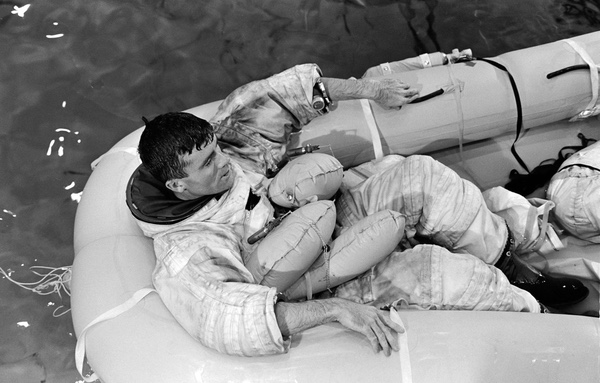 Astronaut Fred W. Haise Jr., lunar module pilot of the Apollo 13 lunar landing mission, participates in water egress training in a water tank in Building 260 at the Manned Spacecraft Center (credit: NASA) |
Return to panic: How two iconic NASA astronauts survived the 1970s and beyond
by Emily Carney
Monday, September 19, 2022

“Songs are as sad as the listener,” author Jonathan Safran Foer wrote in the novel Extremely Loud and Incredibly Close. Indeed, perspective—and time—are things that color one’s thoughts, particularly when times get tough. Two NASA astronauts who perhaps had the most challenging times of all during the 1970s were Buzz Aldrin, Gemini 12 veteran and Apollo 11 moonwalker, and Fred Haise, who just missed the Moon during 1970’s Apollo 13. Within two years of triumphantly becoming one of the first humans ever to walk upon the lunar surface, Aldrin graduated from being feted by world leaders to being hospitalized for worsening clinical depression and alcoholism. Within three years of surviving Apollo 13’s oxygen tank explosion and tumultuous return, Haise was entangled in yet another fight for his life—this one somehow magnitudes worse than weathering numerous technical failures in deep space.
Analyzing Aldrin’s 1973 memoir Return to Earth, interviews conducted by Aldrin during and after his hospital experience, Haise’s recently-published autobiography Never Panic Early, and Haise’s just-released diaries reveal how two men with very similar jobs—both were supremely gifted lunar module pilots during their respective Apollo flights—dealt with their hardships in disparate ways.
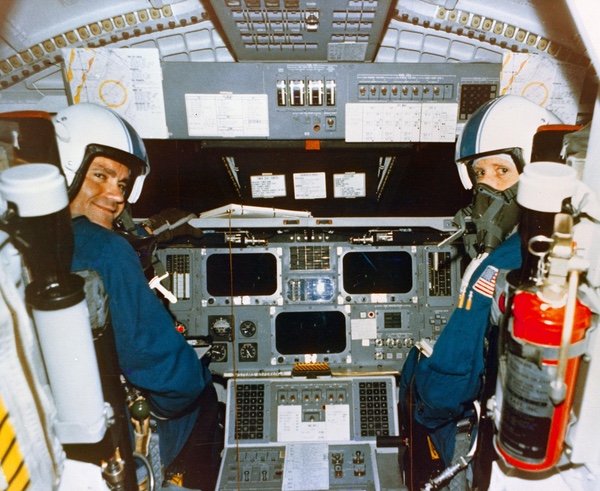 Astronauts Fred W. Haise, Jr., Commander, left, and C. Gordon Fullerton in the cockpit of the Space Shuttle Orbiter 101 "Enterprise" prior to the fifth and final FF in the Approach and Landing Test (ALT) series, from DFRC. (credit: NASA) |
The door to Hell
Here it is, Dec. 23 [1973] and I finally am in the proper frame of mind to catch you up diary. To take [you] through some very dark days.
– Haise’s first diary entry after his near-fatal August 1973 plane crash
It bears mentioning that Return to Earth (written with author Wayne Warga) and Never Panic Early (written with space historian Bill Moore) were written at different phases of Aldrin’s and Haise’s lives. Aldrin’s memoir was published when he was 43, while Haise was 88 and had more decades to process the events that defined his life for better and worse. Haise’s book—mercifully—spends little time on Apollo 13, which has already been written about and documented by multitudes of writers. More fascinatingly, Haise satiates space history enthusiasts with his stories about Apollo and early Space Shuttle development, flying the Enterprise Approach and Landing Tests of 1977, and his role in moving other space projects forward as a Grumman executive. But the dramatic fulcrum of Never Panic Early occurred on August 23, 1973, when 39-year-old Haise, in his words, “encountered one of those sharp turns in the road after I joined a group then known as the Confederate Air Force and now as the Commemorative Air Force.” Like many of his fellow astronaut colleagues, Haise enjoyed flying in his free time outside of NASA duties.
| Two men with very similar jobs dealt with their hardships in disparate ways. |
Haise was piloting a Vultee BT-13 Valiant dive bomber to Galveston, Texas, to have it cleaned for an upcoming air show in Dallas. He wrote, “At about 300-feet altitude, headed south toward the Gulf of Mexico, the engine started sputtering and cutting out.” Haise, who had experienced engine failures before as a test pilot, searched for a suitable landing site as the engine kept cutting in and out. Haise touched down upon uneven terrain, then one landing gear failed, crashing a wingtip into the ground. The plane cartwheeled and burst into flames; Haise was trapped upside down with flames licking his body’s lower half. He managed to flip himself and kick through the cockpit’s canopy. Walking in a daze to a family’s porch to wait for an ambulance, his vision started to white out. Haise assumed the heat from the flames had burned his eyes. He later realized the “whiting out” was a symptom of shock from the horrific burns he had just sustained. (In his diaries, he recollected that when his vision returned, he exclaimed, “Oh, happy day!”)
He later referred to his following memories as “entering the door to Hell.” The first procedure he underwent at the University of Texas Galveston Hospital was being lowered into a water tank to remove his World War II-era cloth flight suit, which was stuck to his burned body. Having suffered second and third-degree burns on 65 percent of his body (mainly his legs), he hung between the specter of life and death for the next ten days. Family and friends, including fellow astronaut colleagues Ken Mattingly, Charlie Duke, and Paul Weitz, kept a 24-hour vigil, taking shifts while his life hung in the balance. “After ten days, they took me off the critical list and told me that I could look forward to living for a while longer,” Haise wrote.
Here's where Haise began to take control of his post-crash narrative—and recovery. He informed his medical team that his goal was to return to flight status. His ordeal, however, was far from over. Haise was forced to undergo a medieval-sounding treatment called “debridement,” which removed damaged skin from the third-degree areas. In Never Panic Early, he remembered, “During this several hour process, my nurse often had the TV program Soul Train playing. For the next several years, whenever I heard the Soul Train theme music, I immediately remembered those unpleasant days.” Haise spent 11 weeks in the hospital and underwent skin grafting to restore the skin on his legs. The week after he was released, still wearing compression garments to help heal his wounds, he went right back to work at NASA. Haise ends this frankly surreal and terrifying chapter in Never Panic Early with his trademark optimism:
I consider myself to be an extremely fortunate man to have had a passion that tapped into my interests and abilities, and allowed me to draw from all of my life experiences. Changes were definitely in store for America’s space exploration program. During this time, the last Apollo had flown, Skylab needed a shuttle to boost it to a higher orbit, and Columbia’s first shuttle mission to space was more than five years away.
Haise’s new website, created with Logan Jaeren, has made available his diaries from this period and further takes control of his life’s narrative. These diaries are consistent with the theme of survival depicted in Never Panic Early. Haise began visiting children at a local Shriners hospital who had sustained injuries like his to show them that recovery was possible. His diaries from this time are often heartbreaking. An entry from June 23, 1974, read, “About 1/3 [of patients] seemed to be less than two years old this time. Several others were too sedated to talk to sensibly. One little fellow about five covered with the netting type gauze called me Daddy…kept asking when his parents could come.” (Ostensibly, the child’s parents couldn’t visit due to infection and communicable disease risks.)
| The book and diaries betray the gritty determination of someone who not only survived but thrived, |
Many of his 1974 diary entries expressed his determination to regain his flight status. An entry from November 14, 1974, read, “[I] am sorry I cannot report being successfully through flight physical & return to flight status. [I] will accomplish before end of year which was my original decreed milestone. [I] will make it with better odds than Shuttle’s key milestones.” He was correct in that he would make it before the shuttle did. By 1977, not only had Haise returned to flight status, but he was flying the ultimate experimental plane: Space Shuttle Enterprise. But that’s a story for another time. Never Panic Early and Haise’s diaries—nearly 50 years apart—are written from the same perspective; they betray the gritty determination of someone who not only survived but thrived.
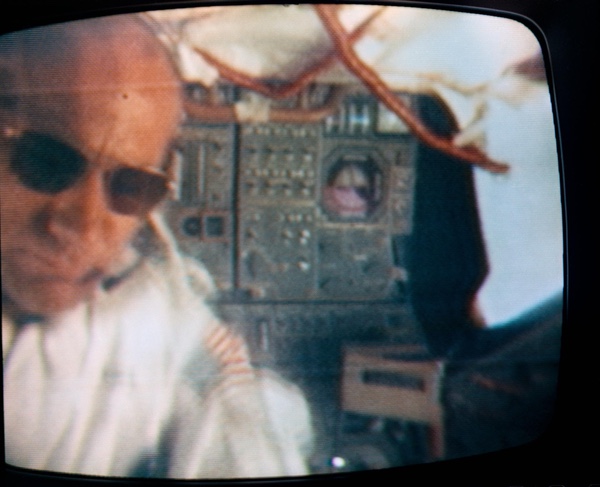 The face of astronaut Buzz Aldrin, lunar module pilot of Apollo 11 lunar landing mission, is seen in this color reproduction, taken from the third television transmission, from the Apollo 11 spacecraft during its trans-lunar journey toward the moon. (credit: NASA) |
I myself am Hell
Life changed dramatically and irreversibly. It would be nearly three years later when, as a patient at the Lackland Air Force Base Hospital in San Antonio, Texas, I found myself standing one night looking at a ripe full moon presiding over a clear cool sky, that the experience could come full circle to a new beginning. What I said to myself was simple enough: “You’ve been to the moon. You did it. First. It cannot be done again, not by you, not by anyone else. Now get the hell out of here and live the kind of life you want.” But getting to that moment proved to be one long and torturous journey.
– Buzz Aldrin, Return to Earth
Thanks to Apollo 13’s oxygen tank explosion, Fred Haise barely missed the Moon. Buzz Aldrin’s 1973 memoir Return to Earth is the story of someone who made it to the lunar surface—but barely survived during the ensuing years, thanks to a volatile cocktail of alcohol, depression, marital strife, social anxiety, generational trauma, and the repercussions of having a toxic parent. Its tone is as far from Never Panic Early as can be; it could be alternately titled Always Panic. Aldrin’s recollections of the severe anxiety he experienced during the post-Apollo 11 world tour—particularly during public speaking—induce the same feelings in the reader. Chaotic, shocking as it is revelatory, and sometimes very sad (and maddening), it’s the astronaut version of Jennette McCurdy’s I’m Glad My Mom Died. One feels bad for Aldrin but, at the same time, is sometimes incensed by his decision-making (particularly when he decides, immediately after his hospitalization, that it’s a good idea to dump his longtime wife, Joan).
At the time of its publication, Aldrin's book was downright radical in its admissions of mental illness and bad behavior. The military, which had been part of Aldrin’s life practically since birth, as his father was a Colonel in the Army Air Corps during both World Wars, has never been sympathetic concerning issues such as depression and anxiety. Mental illness among NASA astronauts, especially during the machismo-dominated 1960s and early 1970s, couldn’t and wouldn’t have been accepted. While Return to Earth is often an uncomfortable read, it’s a remarkable document: the first autobiography of its kind admitting that an American hero possessed very human flaws. It’s also notable in that it captured Buzz Aldrin before he became “Buzz Aldrin”—the celebrity of more recent times who shamelessly hawked space and “Get Your Ass To Mars” T-shirts on Dancing with the Stars and WWE Raw.
| Aldrin, in Return to Earth, just stopped short of saying what needed to be said: that his father let him down terribly and set a bad precedent. But in 1973, this message was not something people were ready to read, especially from an American hero. |
Return to Earth’s narrative begins immediately after Apollo 11 splashed down, its crew entering quarantine; like Haise, Aldrin was also 39 when his struggles took hold. Aldrin, mission commander Neil Armstrong, and command module pilot Michael Collins were almost immediately whisked off on an arduous-at-best travel schedule across the United States, then the world. This would be difficult for nearly anyone, much less someone with a genetic predisposition to mental illness; Aldrin’s mother, Marion Moon, died by suicide shortly after his Gemini 12 flight. Unsurprisingly, Aldrin’s anxieties intensified, undoubtedly aided by the copious amounts of Scotch he imbibed. He couldn’t go to the department store to buy a suit or even go to the bathroom without someone following him and asking for an autograph. Within a year, he increasingly couldn’t get out of bed; an appointment to lead the United States Air Force Test Pilot School, which should have been viewed as a plumb assignment, brought no joy, either.
Aldrin’s problems were complicated by a toxic relationship with his father, Edwin Eugene Aldrin Sr. However, it’s doubtful that the younger Aldrin viewed his father in that light when Return to Earth was written. Aldrin Sr. was markedly not pleased that his son was third, not first, in his West Point class; predictably, he was also vexed that his son was second, not first, to set foot on the Moon. Buzz wrote, “[My father] was being questioned [on television] about my years at West Point and he said, ‘Buzz was first in his class in both athletics and scholarship his first year at West Point.’ …But he seldom mentions the fact that when I graduated three years later, I was third in a class of 435. Third place doesn’t hold quite the appeal to him that first place does.”
In Return to Earth, there is a profoundly awkward passage where a commemorative stamp bearing the words “First Man on the Moon” is unveiled depicting only Armstrong, which upset both Aldrins. It’s fair to assume that the elder Aldrin’s hyper-competitiveness influenced his astronaut son’s personality development. It’s also evident that the younger Aldrin’s enmeshed relationship with his father impacted his ability to take control of his own life’s narrative. In stark contrast, Aldrin’s Apollo 11 crewmate Michael Collins almost gleefully admitted in his autobiography Carrying the Fire that he was firmly in the middle of his West Point class and was not an academic whiz but doesn’t seem at all bothered by it (and Collins also had a military father.)
While not as apparent as a burn wound, this generational trauma still profoundly impacted Buzz Aldrin’s life before and after Apollo 11. Before Apollo 11, it spurred him to become the man who got everything he wanted: the jobs, the degrees, the woman, the family, the status, and ultimately, the star-making spaceflight. After Apollo 11, he only felt a lack as one of the people he continually sought the approval of continued to deny it. This is merely one hallmark of the narcissistic parent.
In I’m Glad My Mom Died, Jennette McCurdy wrote, “Brave, kind, loyal, sweet, loving, graceful, strong, thoughtful, funny, genuine, hopeful, playful, insightful, and on and on…Was she, though? Was she any of those things? The words make me angry. I can’t look at them any longer.” McCurdy discussed how parents—no matter how awful, inappropriate, or abusive they can be—are romanticized; after all, being a parent is viewed as one of the highest forms of self-sacrifice. This is why Aldrin, in Return to Earth, just stopped short of saying what needed to be said: that his father let him down terribly and set a bad precedent. But in 1973, this message was not something people were ready to read, especially from an American hero.
Aldrin Sr. died in 1974. Buzz Aldrin did survive the 1970s and, like Haise, rose above his circumstances to help others with similar problems. A BBC Archives interview from 1980, over a decade after his Apollo mission, showed a healthier, clear-minded Aldrin discussing how he got his life back in order: “I learned that it was okay to not be perfect all the time.”
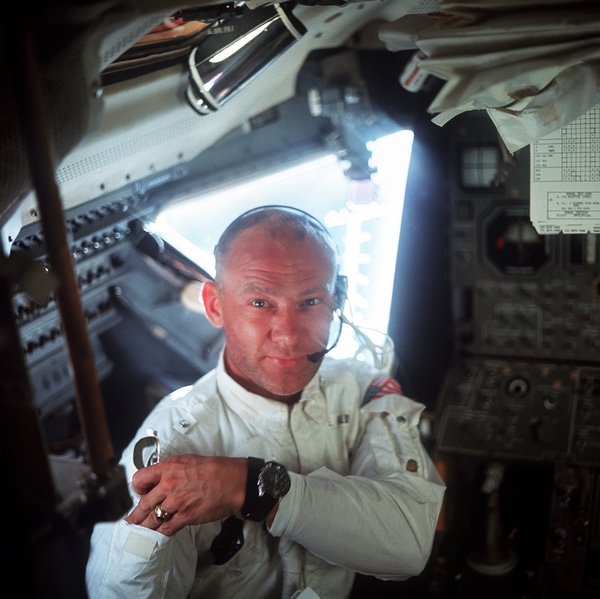 This interior view of the Apollo 11 Lunar Module (LM) shows astronaut Buzz Aldrin, lunar module pilot, during the lunar landing mission. (credit: NASA) |
Some people face adversity but take firm control of their life’s narrative and move ceaselessly forward despite any indignities they sustain. Some struggle, fall upon old crutches, pick at the wounds they suffered during the fight, but slowly recover over time. This is why Fred Haise’s Never Panic Early and Buzz Aldrin’s Return to Earth—both memoirs written by two icons of space from the same era—are so different in tone and execution.
Sources
Aldrin, E. E., & Warga, W. (1973). Return to Earth. Random House.
Fred Haise. (n.d.). Retrieved September 11, 2022.
Haise, F., & Moore, B. (2022). Never Panic Early: An Apollo 13 Astronaut's Journey. Smithsonian Books.
McCurdy, J. (2022). I'm Glad My Mom Died. Simon & Schuster.
The line “I myself am hell” is from Robert Lowell’s poem “Skunk Hour,” published in the book Life Studies in 1959.
Catching Space Debris
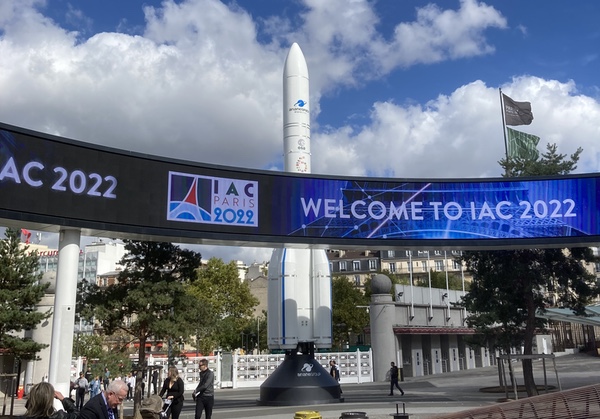 A model of an Ariane 6 greets visitors to the International Astronautical Congress in Paris this week. Keeping that vehicle on track is one of the priorities of the upcoming ESA ministerial council meeting that will fund agency programs for the next three years. (credit: J. Foust) |
Europe seeks to stay in the space race
by Jeff Foust
Monday, September 19, 2022
The 73rd International Astronautical Congress (IAC) started in Paris not on a Monday, as is traditionally the case, but instead on Sunday. The shift was reportedly a scheduling issue: the pandemic that delayed the 2020 IAC in Dubai to 2021 also delayed the 2021 IAC in Paris to 2022, and the only dates available at the convention center that straddles the Boulevard Périphérique, several kilometers from the heart of Paris, required the event to start over the weekend.
| “You realize, especially in Europe, how dependent we are in space on Russia,” said Aschbacher. “We had to decouple our cooperation and our links with Russia very, very quickly. This is something that is not easy.” |
That scheduling has not deterred turnout: more than 8,700 people have registered for the five-day conference, a record. (Being in Paris helps, no doubt; the event may not be so popular next year in Baku, Azerbaijan.) A large fraction of them made it to the opening ceremony at 9:30 a.m. on Sunday morning for the usual pomp and circumstance and entertainment, including a performance by the French Olympic breakdancing team.
There was also, though, politics. The event featured several French and European Union officials who used the ceremonies not just to welcome attendees to Paris and offer generic platitudes about space but also to make political points. Valérie Pécresse, president of the regional council of Île-de-France, the region that includes Paris, called for greater European support for the Ariane 6.
She was also critical of what she saw as unchecked commercial activities in space. “Space should not be dominated by market forces,” said Pécresse, an unsuccessful conservative candidate for the French presidency earlier this year. “Space should not be a hunting ground for billionaires.”
Later, Élisabeth Borne, the French prime minister, spoke at the opening ceremony, using the event to announce a major increase in government spending for space. She announced the government would allocate more than nine billion euros to space programs for the next three years, funding that would go to the French space agency CNES as well as France’s contribution to the European Space Agency (ESA). That funding represented a 25% increase.
“It’s very good news,” Philippe Baptiste, president of CNES, said of the budget increase at a press conference later in the day. He added, though, that the allocation of funding to CNES, ESA and other initiatives remained to be determined.
That announcement, and the conference itself, comes at a critical time for ESA. The agency is preparing for its triennial ministerial council meeting in November where its 22 member states will meet and make funding decisions for the agency for the next three years. At the meeting there are debates and deals made behind closed doors about both existing programs and new proposals.
| “Our proposal of a 25% increase is more or less keeping pace” with the US and China, said Aschbacher. “What we are aiming at doing is making sure we are not thrown out of the race.” |
The ministerial is difficult enough in normal times, like the last one in 2019 (see “Funding Europe’s space ambitions”, The Space Review, December 2, 2019.) The upcoming meeting faces even bigger challenges, though. European economies are struggling from the aftermath of the pandemic and, more recently, Russia’s invasion of Ukraine. Inflation, recession fears, and increasing concerns about an energy crisis this winter because of a cutoff in Russian oil and gas are all wearing on Europeans.
The Russian invasion also affected ESA, wiping out significant levels of cooperation. ESA’s ExoMars rover mission, which was to launch this month on a Proton rocket, is instead still on the ground, its launch delayed until at least 2026. The loss of Soyuz has forced ESA to scramble to find new rides for several missions, a problem exacerbated by continued delays in the Ariane 6, whose first launch is now not expected until some time next year.
“You realize, especially in Europe, how dependent we are in space on Russia,” said Josef Aschbacher, director general of ESA. “We had to decouple our cooperation and our links with Russia very, very quickly. This is something that is not easy.”
ESA is leaning into those challenges. Speaking last week at another conference, World Satellite Business Week, Aschbacher announced ESA would request more than 18 billion euros over the next three years from member states at the ministerial (specifically, he later tweeted, 18.7 billion euros.) That would be a 25% increase over what ESA secured at the previous ministerial in 2019.
“I’m putting together a very ambitious package despite the current situation, despite the economic difficulties we have, because I firmly believe that, if we are not doing that, we will make a huge mistake in Europe,” he said.
That proposed increase is a response to ESA’s previous dependence on Russia, he said. “This realization of the dependence that we had is certainly a trigger and a message that I get very clearly, to make a package of ministerial proposals that is resilient, increases our independence and strengthens our European space sector overall to make sure that we can do what we need to do.”
Exactly what is in the ministerial remains under wraps. However, Aschbacher and other ESA officials have talked about increases in existing science, technology, and exploration programs, along with investment in new ones. That includes, on the exploration side, work on a large cargo lunar lander called the European Large Logistics Lander that could support later Artemis missions, as well as Moonlight, a lunar satellite communications network.
Asking for more money as European tighten their belts is no easy feat, with Aschbacher calling it more challenging than any previous ministerial. “This is not a good boundary condition for a ministerial conference,” he acknowledged. “Still, I believe that, because of this situation in which we are, we have to invest in space.”
“We are in a very intense phase of defining the elements of our program proposals to ensure countries’ interests,” he said at Sunday’s IAC press conference. “The members states are defining back home their contributions and their roles in the various programs.”
“We all hope that, despite the circumstances, as I mentioned before, the importance of space is recognized by the finance ministers, because, at the end of the day, they are the ones providing the funding,” he added.
In that regard, the French prime minister’s announcement earlier in the day was encouraging, provided France’s contribution to ESA increases in lockstep with its overall spending increase. Whether other major ESA nations follow suit, and how they decide to allocate their budgets, remains to be seen.
“Our top priority in Germany is a strong ESA,” said Walther Pelzer, director general of the German Space Agency, during a roundtable about the ministerial at IAC on Sunday. That means showing a united front in Europe that has maintained since the start of the war, he said.
| “The big challenge at the end is to get all the member states going in the same direction,” said Anna Rathsman. |
Those countries, though, will still be pushing for their own priorities at the ministerial, arguing they are as vital to European interests as they are to their own national interests. “There is some kind of love story between France and launchers,” said CNES’s Baptiste at the roundtable. (“Love and hate,” he added.) “We have always invested a lot on launchers. This is something which we believe in, because there is no European strategy in space if you don’t have European access to space.”
Aschbacher used the session to defend the proposed 25% budget increase, saying it was necessary to keep up with other major space powers, notably the United States and China. (NASA received about $24 billion in fiscal year 2022, an increase of 12% from 2019.) “Our proposal of a 25% increase is more or less keeping pace,” he said. “What we are aiming at doing is making sure we are not thrown out of the race.”
There is still a lot of work, and a lot of lobbying, to be done before ministers gather in Paris in late November for the council meeting. “The big challenge at the end is to get all the member states going in the same direction,” said Anna Rathsman, director general of the Swedish National Space Agency and chair of the ESA Council.
Aschbacher said he’ll be satisfied with the outcome of that meeting, one that will decide the fate of ESA programs for the next three years, if those ministers are satisfied. “The measure of success” he said, “is that the member states, when they come to the table at the ministerial level, are satisfied at the end of the day, and think they’ve done the right thing and the right decisions, and go home smiling.”
Note: we are using a new commenting system, which may require you to create a new account.
Europe Seeks To Stay In The Space Race
A model of an Ariane 6 greets visitors to the International Astronautical Congress in Paris this week. Keeping that vehicle on track is one of the priorities of the upcoming ESA ministerial council meeting that will fund agency programs for the next three years. (credit: J. Foust) |
Europe seeks to stay in the space race
by Jeff Foust
Monday, September 19, 2022
The 73rd International Astronautical Congress (IAC) started in Paris not on a Monday, as is traditionally the case, but instead on Sunday. The shift was reportedly a scheduling issue: the pandemic that delayed the 2020 IAC in Dubai to 2021 also delayed the 2021 IAC in Paris to 2022, and the only dates available at the convention center that straddles the Boulevard Périphérique, several kilometers from the heart of Paris, required the event to start over the weekend.
| “You realize, especially in Europe, how dependent we are in space on Russia,” said Aschbacher. “We had to decouple our cooperation and our links with Russia very, very quickly. This is something that is not easy.” |
That scheduling has not deterred turnout: more than 8,700 people have registered for the five-day conference, a record. (Being in Paris helps, no doubt; the event may not be so popular next year in Baku, Azerbaijan.) A large fraction of them made it to the opening ceremony at 9:30 a.m. on Sunday morning for the usual pomp and circumstance and entertainment, including a performance by the French Olympic breakdancing team.
There was also, though, politics. The event featured several French and European Union officials who used the ceremonies not just to welcome attendees to Paris and offer generic platitudes about space but also to make political points. Valérie Pécresse, president of the regional council of Île-de-France, the region that includes Paris, called for greater European support for the Ariane 6.
She was also critical of what she saw as unchecked commercial activities in space. “Space should not be dominated by market forces,” said Pécresse, an unsuccessful conservative candidate for the French presidency earlier this year. “Space should not be a hunting ground for billionaires.”
Later, Élisabeth Borne, the French prime minister, spoke at the opening ceremony, using the event to announce a major increase in government spending for space. She announced the government would allocate more than nine billion euros to space programs for the next three years, funding that would go to the French space agency CNES as well as France’s contribution to the European Space Agency (ESA). That funding represented a 25% increase.
“It’s very good news,” Philippe Baptiste, president of CNES, said of the budget increase at a press conference later in the day. He added, though, that the allocation of funding to CNES, ESA and other initiatives remained to be determined.
That announcement, and the conference itself, comes at a critical time for ESA. The agency is preparing for its triennial ministerial council meeting in November where its 22 member states will meet and make funding decisions for the agency for the next three years. At the meeting there are debates and deals made behind closed doors about both existing programs and new proposals.
| “Our proposal of a 25% increase is more or less keeping pace” with the US and China, said Aschbacher. “What we are aiming at doing is making sure we are not thrown out of the race.” |
The ministerial is difficult enough in normal times, like the last one in 2019 (see “Funding Europe’s space ambitions”, The Space Review, December 2, 2019.) The upcoming meeting faces even bigger challenges, though. European economies are struggling from the aftermath of the pandemic and, more recently, Russia’s invasion of Ukraine. Inflation, recession fears, and increasing concerns about an energy crisis this winter because of a cutoff in Russian oil and gas are all wearing on Europeans.
The Russian invasion also affected ESA, wiping out significant levels of cooperation. ESA’s ExoMars rover mission, which was to launch this month on a Proton rocket, is instead still on the ground, its launch delayed until at least 2026. The loss of Soyuz has forced ESA to scramble to find new rides for several missions, a problem exacerbated by continued delays in the Ariane 6, whose first launch is now not expected until some time next year.
“You realize, especially in Europe, how dependent we are in space on Russia,” said Josef Aschbacher, director general of ESA. “We had to decouple our cooperation and our links with Russia very, very quickly. This is something that is not easy.”
ESA is leaning into those challenges. Speaking last week at another conference, World Satellite Business Week, Aschbacher announced ESA would request more than 18 billion euros over the next three years from member states at the ministerial (specifically, he later tweeted, 18.7 billion euros.) That would be a 25% increase over what ESA secured at the previous ministerial in 2019.
“I’m putting together a very ambitious package despite the current situation, despite the economic difficulties we have, because I firmly believe that, if we are not doing that, we will make a huge mistake in Europe,” he said.
That proposed increase is a response to ESA’s previous dependence on Russia, he said. “This realization of the dependence that we had is certainly a trigger and a message that I get very clearly, to make a package of ministerial proposals that is resilient, increases our independence and strengthens our European space sector overall to make sure that we can do what we need to do.”
Exactly what is in the ministerial remains under wraps. However, Aschbacher and other ESA officials have talked about increases in existing science, technology, and exploration programs, along with investment in new ones. That includes, on the exploration side, work on a large cargo lunar lander called the European Large Logistics Lander that could support later Artemis missions, as well as Moonlight, a lunar satellite communications network.
Asking for more money as European tighten their belts is no easy feat, with Aschbacher calling it more challenging than any previous ministerial. “This is not a good boundary condition for a ministerial conference,” he acknowledged. “Still, I believe that, because of this situation in which we are, we have to invest in space.”
“We are in a very intense phase of defining the elements of our program proposals to ensure countries’ interests,” he said at Sunday’s IAC press conference. “The members states are defining back home their contributions and their roles in the various programs.”
“We all hope that, despite the circumstances, as I mentioned before, the importance of space is recognized by the finance ministers, because, at the end of the day, they are the ones providing the funding,” he added.
In that regard, the French prime minister’s announcement earlier in the day was encouraging, provided France’s contribution to ESA increases in lockstep with its overall spending increase. Whether other major ESA nations follow suit, and how they decide to allocate their budgets, remains to be seen.
“Our top priority in Germany is a strong ESA,” said Walther Pelzer, director general of the German Space Agency, during a roundtable about the ministerial at IAC on Sunday. That means showing a united front in Europe that has maintained since the start of the war, he said.
| “The big challenge at the end is to get all the member states going in the same direction,” said Anna Rathsman. |
Those countries, though, will still be pushing for their own priorities at the ministerial, arguing they are as vital to European interests as they are to their own national interests. “There is some kind of love story between France and launchers,” said CNES’s Baptiste at the roundtable. (“Love and hate,” he added.) “We have always invested a lot on launchers. This is something which we believe in, because there is no European strategy in space if you don’t have European access to space.”
Aschbacher used the session to defend the proposed 25% budget increase, saying it was necessary to keep up with other major space powers, notably the United States and China. (NASA received about $24 billion in fiscal year 2022, an increase of 12% from 2019.) “Our proposal of a 25% increase is more or less keeping pace,” he said. “What we are aiming at doing is making sure we are not thrown out of the race.”
There is still a lot of work, and a lot of lobbying, to be done before ministers gather in Paris in late November for the council meeting. “The big challenge at the end is to get all the member states going in the same direction,” said Anna Rathsman, director general of the Swedish National Space Agency and chair of the ESA Council.
Aschbacher said he’ll be satisfied with the outcome of that meeting, one that will decide the fate of ESA programs for the next three years, if those ministers are satisfied. “The measure of success” he said, “is that the member states, when they come to the table at the ministerial level, are satisfied at the end of the day, and think they’ve done the right thing and the right decisions, and go home smiling.”
Note: we are using a new commenting system, which may require you to create a new account.