Pages

Friday, December 2, 2016

Aliens In The Arctic???????

People in the Arctic are Hearing a Weird Noise Coming From the Seafloor

Image courtesy Wikipedia
.
People near Igloolik, Nunavut, in the Canadian Arctic have reported a mysterious “pinging” noise coming from the seafloor. The Canadian military is investigating, and officials have yet to identify the source.
Locals have been hearing a noise, which they describe as a “ping,” “hum,” and “beep,” and explained that these noises have been heard in the Fury and Hecla Strait, roughly 120 kilometers (75 miles) northwest of Igloolik, for several months now.
This area is known to be populated by plenty of sea mammals in warmer times, but this noise is thought to be scaring the wildlife away from the area. The Canadian armed forces performed various multisensor searches, including a 1.5-hour acoustic search, but they didn’t find anything unusual.
As per CBC News, locals have different theories relating to the origin of the noise, but no source has been confirmed.
Some locals believe this mysterious sound is being generated by Greenpeace to scare wildlife away from the rich hunting ground and save them. However, these rumors have been denied by Greenpeace.
Some believe that it’s related to sonar surveys by the Baffinland Iron Mines Corporation, which mines iron ore from Canada’s Baffin Island. However, the company denied that they are surveying in that area and have any equipment in the water.
For now, the reason behind this noise remains unexplained.

20.53 GB (20%) of 101 GB used
Last account activity: 7 minutes ago

A Great New Movie Honoring African-American Women In The Space Program

http://www.foxmovies.com/movies/hidden-figures

Buzz Aldrin Recovering After Evacuation From The South Pole

Buzz Aldrin recovering after evacuation from South Pole

Second person to walk on the moon fell ill and is in hospital in New Zealand
Buzz Aldrin on the moon on July 20, 1969 © Getty
Buzz Aldrin, the second person to walk on the moon, is recovering in New Zealand after being evacuated from the South Pole on health concerns.
Mr Aldrin was in Antarctica with White Desert, a luxury tourism operator. He fell ill and was evacuated with a doctor to McMurdo, a US research centre on the continent, and then to Christchurch.
He is “recovering well”, according to his Twitter account.
While the 86-year-old astronaut had fluid in his lungs, he was responding to antibiotics and his condition was stable, White Desert said in a statement. His manager described him as being in good spirits, the company added.
Although [Aldrin] was coming as a tourist, he had lots more to it, as well — a big scientific bent to his reasons
Patrick Woodhead, White Desert
Mr Aldrin’s visit to Antarctica, which took place almost half a century after he set foot on the moon, was related to his support of and curiosity around further space exploration, according to Patrick Woodhead, White Desert’s chief executive.
“Buzz was very interested in coming because he’s obviously very interested in Mars and life on Mars and how humans might colonise and inhabit Mars in the future — Antarctica is a very interesting litmus test for living in those kinds of conditions,” he said. “Although he was coming as a tourist, he had lots more to it, as well — a big scientific bent to his reasons.
“He’s just been the most charming man, and absolutely fascinating to listen to. We’re hoping for a lot more dinner conversation about missions to Mars.”
Mr Aldrin was born on January 20, 1930, in Montclair, New Jersey, and graduated third in his class from the US Military Academy in 1951.
Less than six years after being chosen by the National Aeronautics and Space Administration to become an astronaut, he was one of three to explore the moon’s “Sea of Tranquility” region, on July 20, 1969.
He followed Neil Armstrong, who famously described their walk as “one small step for man, one giant leap for mankind”. Mr Aldrin described the surface he saw as “magnificent desolation”.
He was inducted into the Astronaut Hall of Fame in 1993 and was awarded the Congressional gold medal in 2011.
He has become a popular culture star, appearing on TV shows from Tina Fey’s 30 Rock to The Simpsons. He was a contender on Dancing With the Stars, and in 2009 rapped in a Funny or Die video, “Buzz Aldrin’s Rocket Experience”.
Voicing support for President Barack Obama’s push to increase NASA’s funding, he wrote in 2010 that “as an Apollo astronaut, I know the importance of always pushing new frontiers”. He advocated lowering the cost of access to space, working on technologies “to take us further, faster”, and sending people to Mars and other “exciting destinations, as quickly as possible”.
He closed the statement with a poignant note about the effect of space travel: “I am excited to think that the development of commercial capabilities to send humans into low earth orbit will likely result in so many more earthlings being able to experience the transformative power of space flight. I can personally attest to the fact that the experience results in a different perspective on life on Earth, and on our future as a species.”
Copyright The Financial Times Limited 2016. All rights reserved. You may share using our article tools. Please don't cut articles from FT.com and redistribute by email or post to the web.

60 Day Mission Report (Mars 160 Crew@MDRS

MARS SOCIETY ANNOUNCEMENT
View this email in your browser
60-Day Mission Report (Mars 160 Crew @ MDRS)
This report is submitted by Alexandre Mangeot, Crew Commander.
For these 60-day individual reports I asked my crew mates to write about this mission from their personal perspectives. I wanted us to share more than the pictures, the science and technology reports and food recipes. I wanted us to share our feelings as much as it is humanly possible with simple words!
So the crew wrote their parts independently during these few days and the result is just mind-blowing…

Anushree Srivastava – Crew Biologist
My journey of MDRS started off as a volunteer. In 2014, I joined the Mars Desert Research Station (MDRS) Mission Support as a CapCom and that’s how I first became part of this ambitious idea of human exploration of Mars. My job as a CapCom was extremely fulfilling to me as I thought in that way somehow I was assisting to make this idea of manned Mars mission come true in terms of making sure the smooth mission operations, and in turn, facilitating the valuable understanding extracted from the Mars simulation mission. While I was CapCom, I was encouraged to apply to join the Crew by several members of the Mission Support. At that time, I had no idea that my proposal for regular MDRS rotations will make me part of this special long-term Mars simulation mission which was being organised by The Mars Society for the very first time in its history. My joy knew no boundaries, but at the same time, it was a huge responsibility on my shoulders as a Crew Biologist of the Mars 160 mission considering the mission was founded on science operations than just isolation.
This is an ambitious and long-term simulated Mars mission and as a crew biologist, I am working on three principal projects which have significant astrobiological implications: mapping biodiversity of lichens, hypolith abundance and physical ecology, and halophiles in ancient evaporite. Astrobiology addresses the most profound question of humankind – Are we alone? Astrobiology explores the possibility of finding extinct or extant life elsewhere in the universe, as well as investigates the origin and evolution of life on Earth. So, one of the principal targets of our Mars 160 science goals is to explore the extreme niches of the two significant Mars analogs: Utah Desert and Canadian Arctic for 160 days, and studying the extremophile diversity. Personally, I am interested in finding the microbial life in ancient evaporite deposits of these Mars analogs. And our study during the Mars 160 mission will help us understand the potential of finding life in the similar environment on Mars.

Furthermore, this long-term simulation is very important in terms of understanding the human efficiency to conduct science operations on Mars. I perform the astrobiological research here at Mars Desert Research Station as “Mars-based” astronaut-scientist in cooperation with “Earth-based” experts based at NASA Ames Research Centre and Canadian Museum of Science, through asynchronous communication. During this simulation, we are also testing how this communication works between “Mars” and “Earth” based science team which is how it is supposed to be in the real Mars mission.
I had never been part of Mars simulation mission before unlike the other crew members of Mars 160 mission. So this mission is my first attempt to relish the adventure of simulated Mars exploration and performing science in the full-simulation suit. This mission has taught me immense in terms of science and habitation, but above all and for the first time, I learned that how much distance you travel to go to Mars, you have to travel as deep inside you. Through this mission, I learned that humanity’s endeavor of putting feet on Mars someday is actually much more than science, much more than habitability and colonization. I think it is also about forgetting yourself and making something very profound out of you which actually surprise you. I think it is a journey of discovering yourself as well, along with the journey to Mars. It is a very humbling experience. This is what this mission told me.

Jon Clarke – Crew Geologist
As a geologist I have learned much on the expedition. I have been able to build extensively on my previous studies of the sedimentary and landscape history of the MDRS field area. I have also been able to measure basic soil properties in support of the hypolith research to assist identification of the environmental parameters controlling their distribution.
The significance of this increase in scientific understanding has been that it has been acquired entirely while operating under analogue field conditions, while wearing simulated space suits, using the quadbikes, electric rover, and the Hab car for mobility, and with all the restrictions of limited communications over the radio in the field and in limited internet resources in the station. This has shown that it is possible to do useful science not only on singe EVAs as in the past, but continuously, as part of a multi-disciplinary science program, over several months, under.
Also instructive has been working in the larger context of mission support. While all crews at MDRS work within the mission support framework we, because of the extended mission, have learned more about the challenges involved in this process. The familiar questions of how to balance control and autonomy have frequently appeared and the lessons directly applicable to Mars missions where expectations of control by mission control will be modified by the reality of autonomy through imposed by time lags and communication bandwidth.
Many people have said to me “but what will you do while you are there?” The reality of station life is constant activity, much of it routine and labour intensive. Living and working here for nearly three months has shown the importance of efficient facility design and the desirability of automating as many routine operations as possible. These lessons can only be learned by building a station such as MDRS and then incorporating the lessons into new stations which can be then tested by future crews.
Another common expectation have encountered is that people living in close confines like us, will end up in a nasty mess of conflict and other interpersonal problems. The reality has been quite different. We have had few disagreements between us and I am looking forward to working with everyone in the second half of the mission. Life here is nothing like the clichés of bad science fiction or reality TV!

To read the full report, please click here.
Two Mars 160 crew members during an EVA near MDRS in Utah
Facebook
Facebook
Twitter
Twitter
Website
Website
YouTube
YouTube
Share
Tweet
The Mars Society
11111 West 8th Avenue, unit A
Lakewood, CO 80215 U.S.A.
www.marssociety.org
@TheMarsSociety


Copyright (c) 2016 The Mars Society

Thursday, December 1, 2016

Elon Musk May Have A New Partner In His Quest To Colonize Mars


Elon Musk may have a new partner in his mission to colonize Mars


Billionaire Elon Musk and SpaceX may have just found a new partner in their his planned mission to Mars.
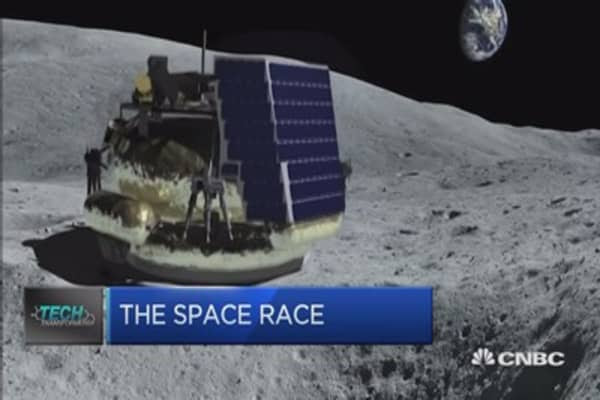
Naveen Jain, the founder of a space exploration company called Moon Express, told CNBC on Thursday that his start-up is willing to work with Musk.
Moon Express is the first private company given permission by the U.S. government to explore the moon for resources. It is planning a mission to take a robotic rover to the moon in 2017.
But Jain said that in Cape Canveral – Moon Express's base – the company has two "neighbors" – Jeff Bezos and his space company Blue Origin, and Musk and SpaceX.
When Jain was asked by CNBC if he would work with Musk, the entrepreneur said "absolutely".
"It's very complimentary as a matter of fact … Elon will build the rocket and we do the rover. Essentially, he lays the cables and we do the last mile," Jain told CNBC in an interview at the Slush technology conference in Helsinki, Finland.
Jain said he has spoken to Musk about working together without giving further details. Earlier this year, Musk laid out his vision to colonize Mars and take a manned mission to the Red Planet in the next ten years.
Making humanity a ‘multi-planetary’ society