Friday, January 13, 2023

Mat Kaplin: In Praise Of A Profound Force In Planetary Exploration
I want to talk today about an incredible man name Mat Kaplan. I have been a fan of his podcast Planetary Radio for 20 years. He is retiring after an incredible career.
Before I go further with Mat, I need to talk about another man, the late
President Richard Nixon. He has a sad place in history. He is hated and reviled
by many people. In my mind, his whole life is a sad collection of "what
might have beens." He had a brilliant mind and so much to give all of us.
His bad character destroyed this potential and the place in history that he
should have. Let me give you a couple of examples of the positive things that
he accomplished. We are now starting to explore the possibility of giving
everyone a guaranteed minimum income. 50 years ago, Nixon implemented an earned
income credit. One went out and worked. If they did not reach the minimum
income that they needed to survive, the person got a check from the U.S. tax
authorities to bring their income up to survival level.
Most of us in the US are covered by Obamacare. Many people love it. 40
years before we had Obamacare, Nixon came up with Nixoncare which was roughly
the same thing. The late Senator Ted Kennedy got it defeated. Labor union
pressure led him to do this. Years later he would say that it was the worst
mistake of his political career.
Unknown to most, Richard Nixon was a painfully shy man. He could not
socialize and "make small talk" with people. He sweated profusely and
felt great fear before making a speech. Despite these limitations, he was a Master
of Television and video media.
Many years ago, Elena and I toured the Richard Nixon Presidential
Library in Yorba Linda, California. It was an awesome and sad experience.
One could find things like the space suits of Apollo astronauts. What touched
my heart was a 1950 wood-panel Mercury station wagon that Nixon used when
campaigning for the U.S. Senate in 1950. He drove around California in
this car. He would stop at many different locations. He would stand on the
car and give political campaign speeches. I tried to imagine how hard it was
for this painfully shy man to do this.
Now please allow me to show you a copy of the retirement message that I sent to
Mat Kaplan yesterday:
Dear Matt:
I am haunted by the
words of General MacArthur from 1964 as follows:
"Old
soldiers never die. They just fade away."
I
joined the Planetary Society in 1997 when I was living in a homeless shelter. I
was working at an $8.00/ hour exploitation job. You can imagine what a big
investment the dues were way back then.
I have listened to
you on Planetary Radio for 20 years (with some absences.) You have entertained
me. You have enlightened me. You have made me laugh. You have incredible
charisma and intelligence. I have met you in person at several Explore Mars
events. Please allow me to make a candid comment here. In person, I can detect
a shyness and reserve in you. Respectfully I am not comparing you to Richard
Nixon. But you two share a trait in common. Both of you are shy men who perform
brilliantly when the microphone or camera red light comes on.
An amazing era has
come to an end. I feel sad in one respect, and I feel happy in one respect. You
are moving on. Sarah is an excellent person to replace you. After ten years or
so, she will fill your shoes.
Enjoy the San Diego
beaches and be at peace.
All my best!
Ad Astra,
--
Jack Waldbewohner
I expected that Mat might
not ever see it as he was inundated with retirement good wishes. I was
pleasantly surprised to get a beautiful response from him:
Dear Jack,
Sarah forwarded your
wonderful letter to me. I was with my ailing mother when I received it,
so she was also able to enjoy my first reading.
Thank you so much for your
beautifully-written and very perceptive message. You've got me
pegged! My wife confirmed it all, and I don't mind the comparison to
Nixon--not for this observation anyway. I'm never happier than when I'm
on stage or doing an interview, yet I'm often terribly shy and uneasy in a
one-on-one, informal conversation. Oh, well.
As I told Sarah, my shoe
size is just 9.5. She is rapidly growing into them.
Now, about your signature
block, I must say that's the most impressive collection of telephone numbers
I've ever seen. I just glanced through the Waltrade website. You
have clearly come a very long way from that shelter. Congratulations on
all you've accomplished. I'm very proud to know that you've been
accompanied by Planetary Radio and the Society on this personal journey.
I've always loved that
Teddy Roosevelt quote. I hope to cross paths with you again soon.
Ad Astra!
Mat Kaplan (he/him)
Senior Communications Adviser
The Planetary Society
60 South Los Robles Ave
Pasadena, CA 91101
tel: 626.793.5100
cell: 562.760.4152
Find your place in space.
Join us today at planetary.org
Another wonderful message
for you, Mat!
Sarah Al-Ahmed (she/her)
Media Producer
Planetary Radio Host
The Planetary
Society
60 South Los Robles Ave
Pasadena, CA 91101
tel: 626.793.5100
Find your place in space.
Join us today at
planetary.org
Thursday, January 12, 2023
Wednesday, January 11, 2023
Brief History Of Black Holes
 |
Review: A Brief History of Black Holes
by Jeff Foust
Monday, January 9, 2023

A Brief History of Black Holes: And Why Nearly Everything You Know About Them Is Wrong
by Becky Smethurst
Macmillan, 2022
hardcover, 288 pp., illus.
ISBN 978-1-5290-8670-6
US$29.95
Black holes probably exist. That was the conclusion of a study publicized last week that examined whether the phenomena widely believed to be black holes might instead be an ultracompact object formed of exotic matter, dubbed a “boson star”. The analysis, though, concluded that such a boson star would last for only a fraction of a second before exploding into a less dense object or collapsing into—you guessed it—a black hole.
| “A black hole isn’t the absence of something; it’s the presence of everything; matter in its densest possible form,” she writes. |
The black hole’s place in our understanding of the universe has become increasing secure over the last half-century. They have gone from theoretical constructs to objects whose existence was inferred by various phenomena to, in recent years, detections by gravitational wave observatories and direct imaging. Their place in popular culture has been even stronger: objects with voracious appetites that suck in anything in their path, never to be seen again.
But in A Brief History of Black Holes, Becky Smethurst, an astrophysicist and science communicator at the University of Oxford, suggests it’s time to rethink our concepts of black holes. The science about them is correct, but our perception of them as holes that objects fall into is all wrong: they are massive mountains that are the brightest objects in the universe.
The book is a popular science overview of our understanding of black holes, and more broadly our evolving understanding of the universe. She balances the science with the scientists to offer a broader perspective of how the concept of black holes emerged, backed by both theory and observations. She goes into some level of detail, including concepts like the Tolman-Oppenheimer-Volkoff limit (the maximum mass of a neutron star) without losing the reader.
Perhaps the most novel argument she makes (and the substance behind the book’s subtitle) is that our conceptualization of black holes is all wrong. “A black hole isn’t the absence of something; it’s the presence of everything; matter in its densest possible form,” she writes. “I like to think of them more like mountains of matter than holes in the ground.”
That extends to the “black” part of the name, noting that the supermassive black holes in the center of galaxies in particular are incredibly bright in X-ray and radio bands because of their accretion disks. “To me, it once again represents one of the most misunderstood concepts about black holes; they’re not ‘black’, they are the brightest things in the entire Universe. Completely unmissable, blazingly bright mountains of matter.”
The term “black hole,” she writes, appears to date back to a 1961 conference where physicist Robert Dicke compared what were then called “gravitationally completely collapsed objects” to the Black hole of Calcutta, the infamous overcrowded prison. Within a decade, the term “black hole” made its way into both popular and scientific literature. She writes she would have preferred a term like “dark star” proposed by John Mitchell in the 18th century for stars so big that light could not escape them.
That said, we are likely stuck with “black hole” given how strongly the term is entrenched in both science and popular culture. But after reading A Brief History of Black Holes, you will have a better appreciation of what those objects really are, and a reminder that names can be deceiving.
Note: we are using a new commenting system, which may require you to create a new account.
Let's Get Commercial Spaceflight Involved In Planetary Missions!
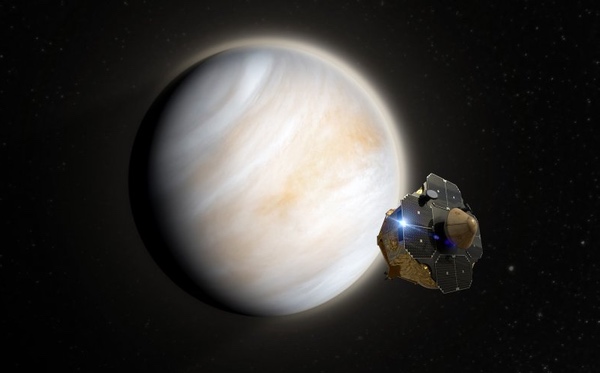 Concepts like Rocket Lab’s private Venus mission might be a way to get around the budget pressures on NASA’s planetary science program. (credit: Rocket Lab) |
A COTS-like alternative for planetary exploration
by Louis Friedman
Monday, January 9, 2023
The recent projection presented by Dr. Lori Glaze, director of NASA’s planetary science division, at the Fall Meeting of the AGU was sobering and should serve as both a warning and a call for action to the planetary science community. She projected a flat budget for planetary science to at least late this decade, despite the growing requirements for the two flagship missions, Mars Sample Return and Europa Clipper, and the broader infrastructure issues raised by the Psyche program delay and post-pandemic supply chain issues. Already we have delays initiated in the smaller, but still large, planetary programs in Discovery and New Frontiers.
| he combination of successes by MarCO and LightSail suggest a new approach: public-private partnerships. Planetary exploration is likely not commercial, but it certainly can be done with public-private partners. |
She noted that the budget projection is below the prioritized list generated by scientists in the most recent decadal study. And, as hopeful as that list might be, even it delays the strongly held scientific interest in exploring the water vents of Enceladus, the possible organic lakes of Titan, and the plethora of Kuiper Belt Objects, including a Pluto deeper dive. Any 40-year-old planetary scientist is likely to be retired by the time of any of those planetary encounters and the principal investigators for data collection on some of them may not have yet been born.
Rather than accepting the conundrum imposed from the stresses, a workaround should be sought. One approach to such a workaround comes from the highly successful initiation of the commercial cargo and crew programs, like Commercial Orbital Transportation Services (COTS). It was not initiated because NASA human spaceflight wanted to give up on their space launch system. It was started as a comparatively low-budget venture as a new way to cope with budget dilemmas. And it worked! Without this approach, the US would be doing a lot less human spaceflight. A similar result is happening with the Commercial Lunar Payload Services (CLPS) program, stimulating more lunar missions.
We have a similar situation in planetary: we may have to delay a lot of missions flying unless we can invest in a low-cost venture to simultaneously exist with and even support the main-line (decadal) plan. That is to be emphasized: I am not recommending a Plan B, just a Plan A’, one that can coexist with and even support the decadal flagships and New Frontiers and Discovery programs (all in billion dollar, or near-billion-dollar, category), but cost an order of magnitude less (e.g. $100 million). There are a few ideas around, but none have NASA interest. With a little investment these ideas could be nurtured.
One is the nascent Venus mission by Rocket Lab, a commercial venture to a planet. Another one that I have been working on is deep-space exploration with small solar sailcraft, enabled by two new successfully demonstrated technologies: interplanetary smallsats like Mars Cube One (MarCO) and solar sails like IKAROS and LightSail. The combination of successes by MarCO and LightSail suggest a new approach: public-private partnerships. Planetary exploration is likely not commercial, but it certainly can be done with public-private partners. Smallsat missions for Mars were also suggested by a Mars Architecture Strategy Working Group.
We could perhaps have fast flybys of Enceladus and Titan, and to the Uranus, Neptune, and Kuiper Belt systems before 2035! That is flybys by then, not just mission starts. They wouldn’t be the decadal desired missions but they could be gap-fillers, scouts, or pathfinders with special purpose instruments. And, in those ways, they can make the eventual decadal missions even better.
Note: we are using a new commenting system, which may require you to create a new account.
The Early 1993 Lunar Access Proposal
 In January 1993, General Dynamics unveiled its Early Lunar Access proposal for returning Americans to the Moon. The company hoped that a new presidential administration would embrace its cheaper method of returning humans to the Moon using existing launch vehicles. But the Clinton administration was already skeptical of NASA's space station program and wary of new civil space expenditures. General Dynamics' study demonstrated that it was difficult to repeat Apollo without much larger launch vehicles. (credit: General Dynamics) |
Moon denied: the 1993 Early Lunar Access proposal
by Dwayne A. Day
Monday, January 9, 2023
Getting to the Moon is hard.
It has been more than half a century since the last humans walked on the lunar surface, or even ventured beyond low Earth orbit. Since that time there have been many proposals to do it again. In January 1993—30 years ago this week—there was a proposal known as Early Lunar Access, and it was an attempt to demonstrate that the Moon could be reached faster, and at less cost, than other proposals during that time period. Although it has become a cliché to claim that the politics of a Moon mission are the tough part and the technology is easy, what Early Lunar Access demonstrated was that many of the technology choices were themselves difficult—there was no such thing as easy lunar access.
 Thirty years ago this week, Aviation Week and Space Technology subscribers received this issue with a cover story about General Dynamics' Early Lunar Access proposal. Soon after, any discussions about returning humans to the Moon stopped for the rest of the decade. |
A stumbling start
In summer 1989, President George H.W. Bush unveiled the Space Exploration Initiative that called for returning Americans to the Moon. NASA’s initial response to the initiative was an expansive report known as the “90-Day Study” that proposed a broad approach including a lunar base, but did not explain the first actions the United States should undertake toward returning to the Moon. The 90-Day Study essentially skipped past the first steps to embrace a bigger vision, which of course included a big price tag, making the entire proposal politically vulnerable. Within days of Bush unveiling his initiative, Congress cut NASA’s budget, indicating it would be a difficult slog to find political support for a return to the Moon. Internal battles in the administration between the National Space Council and NASA leadership did not help, but both the House and the Senate were held by Democrats unwilling to give Bush much support for a new space effort.
| ELA was pitched as an effort to use existing launch vehicles—the Space Shuttle, Titan IV, and perhaps Europe’s Ariane 5—to lower costs. The spacecraft would have been new, but it, too, was based upon existing technology and, the company claimed, some existing hardware. |
By 1992, NASA scaled back to address the initial steps for lunar return in a series of workshops and studies known as the First Lunar Outpost. FLO would have required new spacecraft and a new, large rocket, and although it did not use unproven technology, it required new hardware and infrastructure. (See “Aiming for the Moon, crashing on Earth: The rise and fall of the 1989 Space Exploration Initiative (part 2),” The Space Review, October 31, 2022.) FLO was studied in the summer of 1992, but by this time there was clearly no congressional support for Bush’s initiative. NASA turned its attention to studying a human mission to Mars, with the plan of revisiting the FLO concept and architecture to see how it could be extended to human exploration of the Red Planet. By November, Bush had lost the election, and a new administration would soon enter the White House.
In January 1993, General Dynamics unveiled the Early Lunar Access (ELA) study with a cover story in Aviation Week & Space Technology. The company’s hope was that the Clinton administration might want a proposal for a lower-cost lunar mission. In early May, company officials further discussed the proposal at a one-day symposium on low-cost lunar missions in Washington, DC. (See “Early Lunar Access: An Affordable Approach for Human Return to the Moon” by Paul Bialla, in Low-Cost Lunar Access, AIAA, May 7, AIAA 1993 p.65, and Jeffrey M. Lenorovitz, “GD Goal: Lower-Cost Manned Lunar Missions,” Aviation Week & Space Technology January 18, 1993 p.42.)
 The ELA mission architecture assumed two robotic landings on the Moon before the first human landing followed, perhaps a year or more after the first landing. Because the lunar launch windows were short, NASA would have to quickly launch, assemble, and check out the Lunar Excursion Vehicle before launching the Titan IV with the Centaur and conducting rendezvous and docking prior to sending the spacecraft to the Moon. Doing all of this before the trajectory window closed would have been difficult. The mission design demonstrated that lunar missions using existing launch vehicles were complicated and risky. (credit: General Dynamics) |
Building blocks to the Moon
According to Paul Bialla, General Dynamics’ manager of civil space programs, the lunar program was intended to be bold. “It seems that NASA programs today are oriented toward doing good research and science, but without much excitement and charm. If we want to recapture the imagination of the public and gain support for the space program, we need something with public appeal—not just business as usual,” Bialla told Aviation Week’s Jeffrey Lenorovitz.
ELA was pitched as an effort to use existing launch vehicles—the Space Shuttle, Titan IV, and perhaps Europe’s Ariane 5—to lower costs. The spacecraft would have been new, but it, too, was based upon existing technology and, the company claimed, some existing hardware. The basic assumptions for ELA were to: maximize the use of existing systems and subsystems or their derivatives, achieve a first piloted lunar mission by 2000, provide the capability for crew stay times for up to three weeks on the Moon, provide a shirtsleeve environment for Intra-Vehicular Activity functions (telerobotic lunar rovers), and emplace permanent facilities that can support expansion to larger base operations.
| As usual, the devil was in the details, and anybody who was initially excited that somebody had found a lower cost and faster method for returning humans to the Moon was soon to lose their enthusiasm. |
Each ELA mission would require at least two launches. The Lunar Excursion Vehicle (LEV) would be launched inside a shuttle payload bay and assembled in orbit using the shuttle’s robotic arm. The LEV crew capsule would be similar in shape to the Apollo spacecraft, although smaller. It would be attached to the Lunar Transfer Vehicle, featuring an advanced high performance four-engine liquid oxygen/hydrogen propulsion system that throttles to enable soft landings on the Moon. The engines would be based on the RS-44 or similar rocket engines. It could achieve redundancy via the capability to shut down a diametrically opposed pair in the event of an engine failure.
Two days after the shuttle had launched and the LEV had been assembled and checked out, a Titan IV would launch with a wide-body Centaur upper stage as its payload, putting it into a co-orbit with the shuttle. The LEV would be deployed and rendezvous and dock with the Centaur. The integrated system would be checked out, then launch to the Moon four days after the initial shuttle launch. The Lunar Exploration Vehicle would fly directly to the Moon, without entering a lunar parking orbit or leaving an astronaut in a Command Service Module above the Moon, like Apollo. This approach was similar to the First Lunar Outpost concept, which also did not put a spacecraft in lunar orbit but landed the entire piloted spacecraft, including the ascent vehicle and Earth reentry vehicle, on the lunar surface.
The initial plan was for a robotic LEV to perform the first mission, which Bialla described as “primarily science-oriented.” It would land approximately 9.7 metric tons of scientific and support hardware on the Moon. The equipment could include a geophysical station, telerobotic rover, optical telescope, and solar arrays. It could also include an airlock for a future habitation module. A second mission would also be robotically controlled and carry a habitation module as well as support systems such as a fuel cell power system and environmental control equipment. The habitation module could be built by Italy’s Alenia Spazio, which already had experience with Spacelab carried in the shuttle bay. One option was using a modified version of a logistics module planned for Space Station Freedom.
As usual, the devil was in the details, and anybody who was initially excited that somebody had found a lower cost and faster method for returning humans to the Moon was soon to lose their enthusiasm.
 The overall mission would have involved six launches: three Titan IV rockets and three shuttle launches. The first and second missions would have been robotic and landed science instruments and a habitat module on the Moon, using a common lander. The third mission would have carried two astronauts in a small spacecraft known as the Lunar Excursion Vehicle, and they would have rendezvoused and docked with a Centaur propulsion stage to send them to the Moon. The entire LEV would have lifted off the surface of the Moon and brought the astronauts back to Earth in a descent capsule. (credit: General Dynamics) |
Setting goals
In terms of lunar science, ELA’s goals were to characterize geology and physical properties and establish an early astronomy outpost. An engineering goal was to demonstrate a lunar oxygen processing pilot plant. Because NASA had already publicly discussed FLO, General Dynamics tread carefully, pitching ELA as a precursor to FLO, not necessarily a replacement. ELA could land humans on the Moon a few years before FLO, using existing rockets. The pitch was that FLO could follow, adding capability, like extended stay times on the lunar surface.
ELA was intended to demonstrate new technologies and capabilities:
Human Life Support Technologies:
- Assess effectiveness of EMU lunar spacesuits
- Evaluate crew capabilities for moderate (14- to 21-day) stay times
- Determine crew effectiveness during lunar night
Support of NASA’s First Lunar Outpost:
- Survey and map potential landing sites
- Deploy navigation aids and communication links
- Determine effectiveness of telerobotic rovers
- Test materials and equipment exposed to long duration lunar environment
- Deploy critical supplies and equipment
After President Bush announced the Space Exploration Initiative, one of the ongoing internal debates within NASA and the National Space Council was the degree to which new technology could lower costs. There were no new technologies that could be implemented quickly and without substantial up-front investment. Oxygen generation on the lunar surface was one potentially useful technology. But it would not make an initial lunar landing possible, and even if it was successfully demonstrated, it would require substantial infrastructure to become useful. ELA took the complete opposite approach, attempting to use as much existing technology and hardware as possible, but avoiding FLO’s requirement for a new large launch vehicle. But it quickly demonstrated that there were no shortcuts to returning to the Moon.
 The Lunar Excursion Vehicle would have been carried into low Earth orbit inside a space shuttle payload bay and assembled and checked out over two days. The use of cryogenic propellants in the payload bay, and the requirement for fast on-orbit assembly (assuming no problems) were questionable assumptions. (credit: General Dynamics) |
Devilish details
Although it was supposed to be cheaper than NASA’s First Lunar Outpost—which one independent cost estimate claimed would cost $25 billion, with approximately half of that cost being a new launch vehicle larger than the Saturn V—the ELA design was not simple, requiring six launches, three on-orbit assembly operations, and three vehicle rendezvous and dockings. Missing from General Dynamics’ proposal were many details, like how the astronauts would get from the shuttle to the LEV capsule. Presumably this would require an EVA using the same spacesuits they would later use on the Moon.
| Because NASA had already publicly discussed FLO, General Dynamics tread carefully, pitching ELA as a precursor to FLO, not necessarily a replacement. |
The Centaur stage would not be the existing two-engine variant, but a single-engine version that would use a significantly upgraded RL10 engine like that already in use. Existing RL10s had 15,000 pounds-force (67,000 newtons) of thrust and the new version would have 35,000 pounds-force (155,000 newtons) of thrust.
The plan unveiled by General Dynamics in January 1993 had some dubious assumptions. One was that the vehicle would carry cryogenic propellants in the shuttle payload bay, something NASA had ruled out after the Challenger accident seven years earlier. Another issue was that the vehicle mass exceeded the safe shuttle abort landing weight, meaning that it would have to dump hydrogen and oxygen overboard during an abort, requiring modifications to the shuttle orbiter.
But General Dynamics acknowledged other troubling aspects of the proposal a few months after unveiling the concept in Aviation Week. During the May 1993 low-cost lunar access symposium in Washington, DC, the company stated that the spacecraft, including the Centaur transfer stage, were too big for the existing launch vehicles. The payloads intended for the shuttle exceeded shuttle’s capabilities and required upgrades to carry 25,720-kilogram payloads to a 300-kilometer orbit. This would necessitate either a lightweight external tank or advanced solid rocket motors. NASA eventually adopted the new tank, but the improved booster rockets were canceled. The expendable launch vehicles would have also required upgrades, although details were scant.
The proposed schedule for ELA was aggressive, with a start in 1994, hardware development starting in 1995, and a robotic landing in 1999. This would be followed six months later by the second robotic mission carrying the habitat, and then six months after that the piloted mission would carry two astronauts to the Moon in 2000. General Dynamics estimated that the cost would be $13 billion over seven years—about half the cost of FLO—but could be as low as $10 billion using “modern management” techniques. European participation could bring the cost for the United States down to $6–9 billion, the company claimed. The marginal cost of continuing the program after the first crewed mission would be $2 billion per mission. A fourth expedition could land additional equipment, supplies and spares for an additional two to three piloted missions to the same landing site.
Moon denied
When General Dynamics began working on the ELA proposal in 1992, the Space Exploration Initiative was politically dead. Congress had even zeroed out small lunar precursor missions from NASA’s budget. Although the November election offered some possibility for political change, the election of Bill Clinton soon made the prospects for future space programs even bleaker. The major NASA human spaceflight project at the time was the space station, and the Clinton Administration was skeptical of the station’s cost and value. By spring 1993, the space station was in political jeopardy. Even if it had been technically feasible, General Dynamics’ Early Lunar Access proposal never had a chance.
Discussions of sending humans beyond low Earth orbit faded in 1993, and throughout the rest of the 1990s there was little discussion of the subject in NASA or other government circles. It wasn’t until the early 2000s that the subject would again receive attention within the government. But even now, thirty years later, we’re still waiting for humans to return to the Moon.
The ELA overview presentation can be found here.
Mass Summary for Early Lunar Access Lunar Exploration Vehicle
| CREW CAPSULE | 3,688 kg |
| - Dry weight | 3,071 kg |
| - Fluids | 141 kg |
| - Crew + Supplies | 476 kg |
| LEV | 20,140 kg |
| - Dry mass | 2,649 kg |
| - Fluids | 780 kg |
| - Main propellant | 16,611 kg |
| PAYLOAD ADAPTER | 6,000 kg |
| TOTAL SHUTTLE PAYLOAD | 25,723 kg |
To Get To Mars Go Past Venus
 While a human mission to fly by or orbit Venus would be designed to gain experience for a future human mission to Mars, there is also significant science it could do, such as teleoperating vehicles on the surface and in the atmosphere of the planet. (credit: JHUAPL/Caleb Heidel) |
To go to Mars, do a backflip at Venus
by Jeff Foust
Monday, January 9, 2023
NASA has made clear its long-term human spaceflight aspirations in recent years. The agency’s Artemis campaign will fly a series of crewed missions to the Moon that will become increasingly ambitious: larger crews, longer stays, and more infrastructure. Those missions, along with experience built up on the International Space Station and commercial successors in Earth orbit and on the lunar Gateway orbiting the Moon, will enable human missions to Mars, perhaps as soon as the late 2030s. The schedule and the specifics have yet to be worked out, but the framework is in place.
| A Venus mission, the report concluded, “affords the ability to close knowledge gaps and buttress confidence in technology, concept of operations, and human adaptability before setting out on a Mars expedition.” |
There are alternative concepts, though, for human spaceflight beyond Earth. SpaceX and its founder, Elon Musk, have advocated going directly to Mars with its Starship vehicle, getting there far earlier than NASA’s plans. But as Starship becomes increasingly tied to Artemis, it’s not clear how many resources SpaceX can devote to such visions while carrying out its NASA obligations.
Another concept seems, at first glance, like a diversion from human-to-Mars concepts. In the early years of the Space Age, engineers studied concepts for human flyby missions of Venus, but they fell out of favor as the focus turned to Mars. NASA’s new interest in “opposition-class” Mars missions, which limit the time at Mars to no more than a couple months, offers an opportunity to also conduct a Venus flyby on either the outbound or return legs of the mission.
Some, though, see a value of doing a Venus flyby mission as a precursor for going to Mars. A July 2022 workshop by Caltech’s Keck Institute for Space Studies, attracting participants from NASA, industry, and academia, focused on the science and exploration prospects for a Venus human flyby mission, leading to a report published in September.
A central argument to a human Venus mission is that it offers an intermediate stepping-stone between human missions to the Moon, lasting weeks or months, and a Mars mission with a round trip of as much as three years. “As part of an integrated strategy toward a first mission to Mars, a dedicated mission to Venus has the potential to be a productive and beneficial mission that could expand our human spaceflight operations knowledge in a stepwise manner starting at and around the Moon, continuing to Venus, and then at Mars,” the workshop report states.
Such a mission, lasting one to two years, would test out many of the technologies needed for a cruise to Mars and back, as well as the various human factors issues associated with missions far longer than expeditions in Earth orbit or at the Moon. A Venus mission, the report concluded, “affords the ability to close knowledge gaps and buttress confidence in technology, concept of operations, and human adaptability before setting out on a Mars expedition.”
The simplest mission would be a Venus flyby. One example of such a mission mentioned in the report would launch in August 2034 and return just over a year later, making a close approach to Venus in November 2034. The mission would spend 72 days in the vicinity of Venus, which the report defines as being within one light-minute of the planet: close enough to allow for teleoperation of probes in the planet’s atmosphere or on its surface.
A more complex option is to go into orbit around Venus. Another mission profile in the report offered a mission lasting just over two years, launching in July 2039 and returning in August 2041, spending 450 days in orbit around Venus.
Both concepts have tradeoffs. The flyby mission is straightforward and short, with no requirements for maneuvers after Earth departure. However, spending a relatively short time in the vicinity of Venus limits the scientific return from the mission, particularly when compared to other robotic missions in development for launch in the next decade.
“It would be a highly expensive venture, which would no doubt produce some amazing imagery and useful additional data,” wrote one critic, Andrew Coates of the Mullard Space Science Laboratory at University College London. “However, this would add little to the detailed and much longer bespoke studies currently planned.”
An orbiting mission would address the scientific return question by spending more than a year in orbit. However, the mission is more complex, with critical maneuvers required to enter and exit orbit around Venus. A similar Mars orbiting mission included in the report as a comparison would be somewhat longer—982 days—and require more delta-V, but would be closer to the goal of a human Mars landing.
The Keck workshop, though, found a middle ground between the flyby and the orbital Venus missions. That alternative, dubbed the “Venus Back-Flip” by workshop participants, would involve two flybys of Venus, with the mission staying close to Venus between the two. The first flyby would send the spacecraft out of the ecliptic, loitering over one of poles of the planet (from the perspective of Venus), before making a second flyby to go back to Earth. Such a maneuver, formally called a “pi transfer,” was used by Cassini to adjust its orbit around Saturn, but had not, to the recollection of workshop participants, ever been proposed for a crewed mission.
 An illustration from the report of the “Venus Back-Flip” maneuver that would allow a crewed mission to perform two close approaches to the planet, spending nearly six months in the vicinity of Venus. |
In the sample mission architecture included in the report, the mission would depart Earth in August 2034, making flybys of Venus in November 2034 and March 2035 before returning to Earth in February 2036. The mission would last a year and a half, with nearly six months spent in the one-light-minute vicinity of Venus. Like the flyby, though, the mission would not require any propulsive maneuvers after Earth departure.
“Thus, this presents an opportunity to be the first human interplanetary mission, set a new flight duration record, present longer time for science teleoperation, and gain valuable human health and performance knowledge for deep space all while on a free-return trajectory,” the report stated.
The report emphasized the scientific benefits of having humans in the vicinity of Venus, including the ability to teleoperate probes and make decisions in realtime. That could build upon upcoming robotic Venus missions by NASA, ESA, and others, it argued.
| “The combination of the intrinsic motivation of individuals and the potential signaling value for nation states or individuals suggests that once it is possible and practicable to achieve, someone will try to achieve it.” |
Perhaps the biggest challenge for a Venus crewed mission is finding public and political support for it. One chapter examines some steps for doing so, like advocacy organizations devoted to Venus—analogous to Mars-focused groups like The Mars Society—and arguments for doing so, from comparative planetology (what Venus can teach us about climate change on Earth) to a “cosmic paradigm shift” of seeing another planet up close to the first time.
A Venus flyby or orbital mission, the report argued, might be easier to sell than its Martian equivalent. “Some see it as politically and popularly untenable to have a first human Mars mission that does not land—in other words, if humans are going to Mars, the public will want them to land,” it stated. That is not an issue for Venus, where a human landing is not feasible for the indefinite future. “This makes planning and designing such a mission potentially simpler and cheaper while still maintaining high public engagement and interest.”
A Venus flyby mission could be a “shakedown cruise” for the habitat intended for going to Mars (presumably with some modifications to account for a different thermal environment, for example), offering a test of that system before going on a longer mission to Mars. However, the report acknowledges NASA won’t decide for some time what kind of shakedown cruise, if any, it will conduct for a Mars vehicle.
Venus mission advocates face an uphill climb, for now, to get a crewed Venus mission into NASA’s plans, something the workshop organizers acknowledge in the report. “Human missions to Venus are not part of the baseline exploration architecture of NASA or any other organization that participated in the symposium. Missions to Venus are not part of NASA’s current Moon to Mars Objectives,” it stated.
Those objectives, though, are still relatively new, rolled out last May with an updated version in September at the International Astronautical Congress in Paris—the same conference where some Venus workshop participants discussed their new report. That study hasn’t gotten much attention since then, but it does present an option for NASA mission planners to consider as they start to add details to their frameworks for getting humans to Mars.
The report hints at one other rationale that might garner more support, or at least a different kind of support, than just science and preparing for human Mars exploration. “As with any major space exploration achievement, there is a potential signaling value to be claimed by anyone who accomplishes a first human mission to Venus,” it stated. “The combination of the intrinsic motivation of individuals and the potential signaling value for nation states or individuals suggests that once it is possible and practicable to achieve, someone will try to achieve it.”
Note: we are using a new commenting system, which may require you to create a new account.