Pages

Wednesday, January 18, 2023

China's New Space Station Is Open For Business


Tiangong space station
China’s space station serves as both a research outpost and a geopolitical symbol. (credit: China Manned Space Engineering Office)

China’s new space station opens for business in an increasingly competitive era of space activity


Bookmark and Share
The Conversation

The International Space Station is no longer the only place where humans can live in orbit.

On November 29, 2022, the Shenzhou 15 mission launched from China’s Gobi Desert carrying three taikonauts, the Chinese word for astronauts. Six hours later, they reached their destination, China’s recently completed space station, called Tiangong, which means “heavenly palace” in Mandarin. The three taikonauts replaced the existing crew that helped wrap up construction. With this successful mission, China has become just the third nation to operate a permanent space station.

But the station also highlights the country’s policy of self-reliance and is an important step for China toward achieving larger space ambitions among a changing landscape of power dynamics in space.

China’s space station is an achievement that solidifies the country’s position alongside the US and Russia as one of the world’s top three space powers. As scholars of space law and space policy who lead the Indiana University Ostrom Workshop’s Space Governance Program, we have been following the development of the Chinese space station with interest.

Unlike the collaborative, US-led International Space Station, Tiangong is entirely built and run by China. The successful opening of the station is the beginning of some exciting science. But the station also highlights the country’s policy of self-reliance and is an important step for China toward achieving larger space ambitions among a changing landscape of power dynamics in space.

Capabilities of a Chinese station

The Tiangong space station is the culmination of three decades of work on the Chinese human spaceflight program. The station is 55 meters long and is comprised of three modules that were launched separately and connected in space. These include one core module where a maximum of six taikonauts can live and two experiment modules for a total 110 cubic meters of space, about one-fifth the size of the International Space Station. The station also has an external robotic arm, which can support activities and experiments outside the station, and three docking ports for resupply vehicles and crewed spacecraft.

Like China’s aircraft carriers and other spacecraft, Tiangong is based on a Soviet-era design—it is pretty much a copy of the Soviet Mir space station from the 1980s. But the Tiangong station has been heavily modernized and improved.

The Chinese space station is slated to stay in orbit for 15 years, with plans to send two six-month crewed missions and two cargo missions to it annually. The science experiments have already begun, with a planned study involving monkey reproduction commencing in the station’s biological test cabinets. Whether the monkeys will cooperate is an entirely different matter.

Science and a steppingstone

The main function of the Tiangong station is to perform research on life in space. There is a particular focus on learning about the growth and development of different types of plants, animals and microorganisms, and there are more than 1,000 experiments planned for the next ten years.

Tiangong is strictly made and managed by China, but the country has an open invitation for other nations to collaborate on experiments aboard Tiangong. So far, nine projects from 17 countries have been selected.

It remains to be seen how the decommissioning of the International Space Station and operation of the Tiangong station will influence the China-US relationship.

Although the new station is small compared to the 16 modules of the International Space Station, Tiangong and the science done aboard will help support China’s future space missions. In December 2023, China is planning to launch a new space telescope called Xuntian. This telescope will map stars and supermassive black holes among other projects with a resolution about the same as the Hubble Space Telescope but with a wider view. The telescope will periodically dock with the station for maintenance.

China also has plans to launch multiple missions to Mars and nearby comets and asteroids with the goal of bringing samples back to Earth. And perhaps most notably, China has announced plans to build a joint Moon base with Russia, although no timeline for this mission has been set.

Astropolitics

A new era in space is unfolding. The Tiangong station is beginning its life just as the International Space Station, after more than 20 years in orbit, is set to be decommissioned by 2030.

The International Space Station is the classic example of collaborative ideals in space. After the height of the Cold War, the US and the Soviet Union came together to develop and launch the beginnings of the space station in the early 1990s. By comparison, China and the US have not been so jovial in their orbital dealings.

In the 1990s, when China was still launching US satellites into orbit, concerns emerged that China was accidentally acquiring—or stealing—US technology. These concern in part led to the Wolf Amendment, passed by Congress in 2011, which severely restricts NASA from collaborating with China in any capacity. China’s space program was not mature enough to be part of the construction of the International Space Station in the 1990s and early 2000s. By the time China had the ability to contribute to the International Space Station, the Wolf Amendment prevented it from doing so.

It remains to be seen how the map of space collaboration will change in the coming years. The US-led Artemis program that aims to build a self-sustaining habitat on the Moon is open to all nations, and more than 20 countries have joined as partners so far. China has also recently opened its joint Moon mission with Russia to other nations. This was partly driven by cooling Chinese-Russian relations but also because of the war in Ukraine led Sweden, France, and the European Space Agency to cancel planned missions with Russia.

As tensions on Earth rise among China, Russia, and the West, and some of that jockeying spills over into space, it remains to be seen how the decommissioning of the International Space Station and operation of the Tiangong station will influence the China-US relationship.

An event like the famous handshake between US astronauts and Russian cosmonauts while orbiting Earth in 1975 is a long way off, but collaboration between the US and China could do much to cool tensions on and above the Earth.


Note: we are using a new commenting system, which may require you to create a new account.

The Iraqi Space Program


Al Ta’ir satellite
The Al-Ta’ir satellite built by Iraqi scientists and engineers between 1988 and 1990. The satellite would have conducted communications experiments. (credit: Sarmad D.S. Dawood)

From the sand to the stars: Saddam Hussein’s failed space program


Bookmark and Share

During the 1980s, the government of Saddam Hussein sought to develop an indigenous space program and then ran head first into external political roadblocks that made this impossible. Although more than three decades have passed since the end of the Iraqi space program, and Saddam has been dead since 2006, there is still relatively little information available on the Iraqi space program. This article summarizes what is publicly known.

Although more than three decades have passed since the end of the Iraqi space program, and Saddam has been dead since 2006, there is still relatively little information available on the Iraqi space program.

On December 5, 1989, Iraq launched a 25-meter-long rocket from a launch pad 230 kilometers southwest of Baghdad. Iraq described this as a “satellite launch system.” This was only a test of the first stage, and the vehicle’s second and third stages were mockups. The CIA determined that this was not a prototype ballistic missile: it was large and ungainly, and had to be launched from a fixed position making it vulnerable to attack. In a declassified top secret 1990 report, Iraqi Ballistic Missile Developments, the CIA stated that Iraq was indeed trying to build a satellite launching vehicle, but faced many technical challenges, such as staging and guidance.

After the United States invaded and occupied Iraq in 2003, it was possible for US intelligence agencies, as well as the United Nations, to roam Iraq collecting evidence about its various weapons programs. The United Nations Monitoring, Verification and Inspection Commission, known as UNMOVIC, gathered substantial information on various Iraqi ballistic missile programs, including information on the Al Abid space launch vehicle. Much of the information was gathered from documents turned over by the Iraqis in 1995 after a high-level defector prompted the Iraqis to preemptively release documents they had been hiding. The material had been buried at a chicken farm in Iraq. The defector later had second thoughts, returned to Iraq, and was promptly assassinated by the regime. UNMOVIC also gathered additional information after the American invasion in the form of interviews and other documents. That information is contained in a report on various Iraqi weapons of mass destruction. In addition, some information emerged from Iraqi officials involved in their satellite program.

Starting a space program

According to Sarmad D.S. Dawood of the Space Applications Center of the Space Technology Directorate of Iraq’s Ministry of Science & Technology in Baghdad, Iraq’s Scientific Research Council established a research center to develop space technology from 1988 until 1990. The research center started the Al-Ta’ir project, which means “The Bird” in Arabic (although the name, which is also applied to a star in the constellation Aquila, also translates as “flying eagle.”) Al-Ta’ir was a small experimental satellite for conducting communications and ranging experiments. It would have operated in the VHF and UHF amateur frequency ranges.

During a 2010 small satellite conference, Dawood stated in a presentation that the research center built two identical flight-ready satellites. The satellites still existed at that time and were in storage at the Ministry of Science & Technology in Baghdad. The project also included a tracking, control, and communications station.

The research center’s plan was to launch one of the satellites aboard an Ariane 4 rocket, and the spacecraft designers used an Ariane 44L vehicle as their baseline. Their plan was to launch the satellite into an orbit of 350–400 kilometers, presumably as a secondary payload. The Ariane 4 only flew to polar low Earth orbit or to geostationary transfer orbit, but a polar orbit would have limited Iraq’s ability to regularly communicate with its satellite.

The satellite was an octagon with a height of 47 centimeters, a diameter of 74 centimeters, and a mass of 75 kilograms. The interior of the satellite was divided into four bays for holding electronic boxes and withstanding the shock and vibration of launch. The satellite was solar powered, with seven solar panels and backup batteries.

Apparently after being rebuffed by the French government or Arianespace over the use of the Ariane 4 to launch their satellite, Iraq began development of its own rocket to launch the Al-Ta’ir satellite.

The satellite subsystems included an onboard data handling system, a radio frequency communication system composed of VHF and UHF amateur band units that communicated voice and telemetry and telecommand data, and an attitude control system. Thermal control was passive, using light and dark paint.

The satellite was spin stabilized. Attitude control would have been accomplished with a technique first developed by the United States military in the early 1960s consisting of two electrical coils mounted on the top and bottom sides of the spacecraft. When an electrical current was passed through them, these coils would interact with the Earth’s magnetic field, keeping the satellite properly oriented.

Al Ta’ir satellite
In December 1989, Iraq launched its Al Abid space launch vehicle. Only the first stage, which consisted of a cluster of five Scud ballistic missiles, was active. Although the vehicle exploded after 45 seconds, it was considered a successful test of the clustered first stage concept. (credit: UNMOVIC)

Al Abid

Apparently after being rebuffed by the French government or Arianespace over the use of the Ariane 4 to launch their satellite, Iraq began development of its own rocket to launch the Al-Ta’ir satellite. According to UNMOVIC, the rocket reportedly had several names, including Comet and Al-Ta’ir, but it seems likely that the UN agency confused the rocket and satellite programs and that the rocket was always called the Al Abid and the satellite was Al-Ta’ir.

The project was carried out under the overall direction of the Ministry of Industry and Military Industrialization. In mid-1988, the Iraqi government asked Canadian “Supergun” expert Gerald Bull’s Space Research Corporation to study development of a launch vehicle capable of placing a 100- to 300-kilogram payload into a 200- to 500-kilometer orbit, although UNMOVIC reported that the planned initial payload was only 50 kilograms. Space Research Corporation engineers chose to develop a clustered rocket design. The third stage diameter was 1.25 meters, more than sufficient to carry the 0.74-meter diameter Al-Ta’ir satellite. According to Iraqi officials involved in the program and interviewed later, the project was always civilian.

At the time, Iraq had many Scud missiles to provide a technology source. The Scud was a short-range ballistic missile exported by the Soviet Union in large numbers. Iraq had conducted modifications on the missiles to increase their range. Space Research Corporation evaluated several different options, including configurations of four to six extended-burn-time Scud rockets clustered around a single extended-burn-time Scud as a second stage and a new third stage. By early 1989, the Space Research Corporation had settled on a design consisting of five Scuds clustered for the first stage, another for the second stage, and a “double-base propellant” rocket for the third stage.

A second team, apparently consisting of two foreign experts from an unnamed country, also assisted the Iraqis. The foreign specialists proposed a different design: a single Scud as a core stage surrounded by strap-on rockets consisting of four or eight SA-2 liquid propellant rockets from a surface-to-air missile, or four or eight Scud rockets. The second stage would be either liquid or solid propellant, and the rocket would also include an apogee kick motor. Space Research Corporation experts rejected this design approach.

The Iraqi program’s leadership produced a development schedule for the Al Abid with the goal of making the first launch by December 12, 1990. Initially, the design had an enlarged payload shroud to house the satellite, giving it a hammerhead appearance. But General Ra’ad, who oversaw Iraq’s missile development programs (no other details about him are included in the UNMOVIC report), proposed increasing the diameter of the third stage to 1.25 meters, the same as the second, to avoid this hammerhead shape. He also designed a clamshell payload fairing. It is not clear how much the Space Research Corporation engineers were involved in the actual development of the rocket beyond the initial designs. At least one senior Iraqi informed the UN inspectors that Space Research Corporation was not involved, but others have said that the company provided technical assistance when necessary.

By mid-1989, the Al Abid design consisted of a five-Scud first stage, a 1.25-meter diameter liquid-propellant rocket for the second stage, and a third stage that might have been a modified Scud with a larger diameter tank. The Scud is 0.88 meters in diameter, so the second stage was actually wider than the individual Scuds used in the first stage.

Testing and foreign assistance

In December 1989, the Iraqis conducted their first test launch of the Al Abid from a fixed launch site at Al Anbar. Although this was only a test of the first stage, it took place a mere six months after development of the project timeline—a fast pace that UNMOVIC attributed to foreign assistance as well as the “practical approach in modifying and developing different versions of the Scud” that project manager General Ra’ad had pursued. The second and third stages were steel mockups. A videotape retrieved from the Haider chicken farm in 1995 showed that the first stage, with its cluster of five Scuds, worked successfully for 45 seconds until the vehicle exploded. The Iraqis suspected that explosive bolts between the first and dummy second stages may have fired prematurely, causing the accident, but this was still a partial success at getting a complex vehicle off the ground. Many rockets barely leave the pad during their first launch, but the Al Abid had demonstrated that it could get off the ground despite the challenges. (An alternative explanation, which appeared in a 2004 CIA report, stated: “At about Mach 1, the aerodynamic stresses overcame the control authority and the missile inter-stage collapsed, according to an interview with a senior missile official…”)

There is still much confusion about the Al Abid because of its connections to the Iraqi effort to develop a long-range missile for delivering an atomic weapon.

The Iraqis realized that the performance of the second stage was crucial to the overall performance of their rocket. The Scud liquid propellant engine lacked the necessary thrust. They initially sought to increase the performance by increasing the expansion ratio of the engine nozzle and changing the fuel. The Scud nozzle was designed to operate from sea level up, so it was relatively narrow. The second stage would ignite at higher altitude, and if it had a wider expansion nozzle it would improve the thrust performance. The designers changed the expansion ratio from 10 to 30 by adding a skirt. They also changed the TM 185 fuel to diethylenetriamine (DETA) or a mixture of DETA and unsymmetrical dimethyl hydrazine (UDMH). An initial engine test was partially successful until the expansion skirt burned through—a result of being tested at sea level rather than at simulated high altitude.

The Al Abid third stage remains somewhat mysterious, and it is unlikely that work progressed very far on it before the project was canceled. Although UNMOVIC released several crude Iraqi drawings of the rocket at various development stages, they reveal few details of the third stage. One document indicated a single rocket nozzle that seems relatively small given the upper atmosphere requirements for a large expansion rocket nozzle.

The Iraqis also approached two foreign countries to purchase a more powerful engine, but were rebuffed. The countries offered to launch Iraq’s satellites themselves, but would not sell them engines. The Iraqis also apparently began developing a new first-stage engine with four Scud combustion chambers and a single turbopump. However, development work halted with the onset of the 1991 Gulf War.

After the December 1989 test launch, the Iraqis decided that the second and third stages of the Al Abid should be tested separately. They planned a test for autumn 1990 that they referred to as Al Kharief, or “Autumn.” The Al Kharief plan became the focus of international controversy. United Nations inspectors claimed that this was a new missile, whereas the Iraqis claimed that it was simply the upper stages of the Al Abid space launch vehicle.

Around mid-1990, Al Kharief work was proceeding very slowly, prompting a meeting of all relevant parties. Project leaders realized that the development was plagued by disagreements and differing priorities. The Al Kharief test progress slowed to a halt, and the August 1990 Iraqi invasion of Kuwait led to the suspension of all activities. According to General Ra’ad, no final report was ever produced and no drawings of the vehicle were available.

Dual-use rocketry

There is still much confusion about the Al Abid because of its connections to the Iraqi effort to develop a long-range missile for delivering an atomic weapon. At the time that the Iraqis were developing their satellite launching vehicle, Western intelligence agencies strongly suspected that Iraq was actively interested in developing atomic weapons and delivery systems for them. In 1987 Iraq had secretly restarted its atomic weapons program, which had been stagnant ever since an Israeli airstrike took out their nuclear reactor at Osirak—an airstrike that included a young pilot named Ilan Ramon, who would later be killed during the shuttle Columbia accident.

The atomic weapon the Iraqis were trying to build would weigh more than two metric tons with a diameter of 1.25 meters. The missile required a range of 650 kilometers. These requirements were beyond the capabilities of Iraq’s missiles, so the nuclear weapon designers were told that they would have to reduce the size of their planned weapon.

Iraqi work on space launch vehicles did not come to a complete stop after Operation Desert Storm in 1991.

In April 1989, Iraq started work on Project S-13, the development of a long-range nuclear-tipped missile. Initially, Project S-13 evaluated three options: a 1.25-meter diameter missile capable of delivering a one-ton weapon 1,200 kilometers, a derivative of the Al Hussein/Al Abbas missile that could reach 650 kilometers, and an unmodified Scud-B missile with a range of only 300 kilometers. A senior Iraqi military leader later stated in an interview that although the weapons designers declared in 1988 that they wanted a missile ready by 1991, he believed it would take until at least 1993 to produce one.

Whereas the available documents indicate that the Iraqis evaluated three possible missiles as part of their S-13 work, there is some indication that the satellite launch vehicle project—particularly the Al Kharief second and third stage test—was also linked to weapons development. The UNMOVIC report stated that General Amer Al Sa’adi, who was in charge of Iraqi strategic weapons development, claimed that his plan was for the Al Abid space launch vehicle’s second and third stages to form the basis of a missile for delivering an atomic weapon. But General Ra’ad, who was in charge of the Al Abid development, insisted that he was unaware of plans to use his rocket for nuclear delivery and that nobody ever approached him about using the Al Kharief for such a purpose. General Ra’ad may have been unaware of or disagreed with the weapon plans, but UNMOVIC investigators concluded that there was a link between the programs, “although the precise details of the relationships are unclear,” the investigators wrote. UNMOVIC added, “What is clear, however, is that these activities were contributing to the long-term solution for a delivery vehicle for the nuclear weapon under the overall control or oversight of General Amer Al Sa’adi.”

book cover
A new book has information on many Iraqi weapons programs, including its ballistic missiles.

Grounded birds

According to a CIA report produced after the 2003 invasion of Iraq, Iraqi work on space launch vehicles did not come to a complete stop after Operation Desert Storm in 1991. In a section of the report called “Multistage Launch Vehicle Simulations (1990-95),” the CIA stated that in 1991–92, Iraq conducted flight simulations of a three-stage missile incorporating Scud-type missiles. The CIA stated that the United Nations had information from an Iraqi official that this was a theoretical study that included trajectory calculations for several clustered SA-2 surface-to-air missile engine configurations. The configuration was different from that of earlier work conducted on Al Abid.

In 1993, Iraqi engineers were ordered to design a turbopump capable of simultaneously feeding a cluster of four SA-2 engines. But no turbopumps or engine clusters were produced. At the end of 1994 through early 1995, Iraq performed studies for multi-stage launch vehicles using performance parameters derived from clustered SA-2 engines. But these paper studies apparently ceased in 1995, and the country abandoned plans for its own space launcher and space program.

Recently, Ali Altobchi, along with Tom Cooper and Adrien Fontanellez, published a new book on Iraqi conventional weapons efforts. Titled Al-Hussein – Iraqi Indigenous Conventional Arms Projects, 1980-2003, the book is heavily illustrated and covers many different projects, from ballistic missiles to aircraft and artillery weapons. Unfortunately, the book only has a short entry on the Al Abid (referred to as “Al-Aabed” by the authors). The authors state that nosecone heating was too big a problem for the designers to overcome, although a space launch vehicle would have experienced less heating during ascent than a ballistic missile nosecone, so the statement is confusing.

If any Iraqis involved in the launch vehicle program have told their stories, we have yet to learn about them three decades later. The full history of the Iraqi space program has still not been written.


Note: we are using a new commenting system, which may require you to create a new account.

Unlocking The Next Great Observatories


JWST
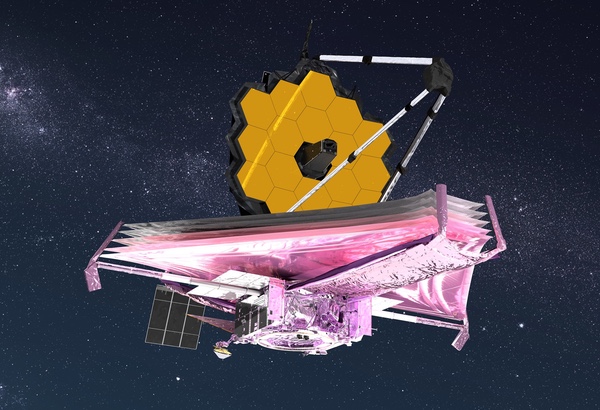
The success of JWST, exceeding requirements in nearly every way, allows NASA to focus now on development of future large space telescopes. (credit: NASA GSFC/CIL/Adriana Manrique Gutierrez)

Unlocking the next great observatories


Bookmark and Share

When astronomers gathered in Seattle last week for the 241st Meeting of the American Astronomical Society (AAS), one of the largest conferences of astronomers, there was a celebratory mood among many there. The meeting was the first by the AAS since the release last July of the first science images from the James Webb Space Telescope that marked the start of a new era in the field after years—decades, really—of anticipation.

JWST was front and center for much of the conference. Astronomers presented new research from early observations by the telescope, from the discovery of a rocky, Earth-sized exoplanet to distant early galaxies. After years of anticipating what JWST could do, they were now starting to reap the benefits that had long been promised.

“JWST was artisanal. It’s really made by hand,” Rigby said. “That scientific performance that is better than expectations is because of a tremendous amount of work by 20,000 people around the world.”

In presentations at the meeting, project scientists and managers said the telescope continued to meet or exceed requirements. “The high-level message is that it really is better than we expected across the board,” said Jane Rigby, operations project scientist for JWST at NASA’s Goddard Space Flight Center, in a plenary talk January 9 that ended with a prolonged standing ovation.

The telescope, she said, was doing far better than required on factors such as sensitivity, stability, and resolution. The accuracy of its launch a little more than a year ago on an Ariane 5 reduced the need to use propellant for course corrections on its way to the Earth-Sun L-2 point. She said NASA now estimates it has enough stationkeeping propellant to operate for more than 20 years, double the agency’s estimates before launch.

She credited that performance to the attention to detail during its construction. “JWST was artisanal. It’s really made by hand,” she said. “That scientific performance that is better than expectations is because of a tremendous amount of work by 20,000 people around the world.”

At a town hall meeting for JWST held at the conference January 9, project officials did discuss some minor issues with the telescope. One that had attracted attention even during spacecraft commissioning was micrometeoroid impacts on the telescope’s mirror segments, including one in May that was larger than anticipated.

Jonathan Gardner, deputy senior project scientist for JWST at NASA Goddard, said there have been 21 micrometeoroid impacts to date, only one large enough to be of any concern. Combined, he said, they have had “only a very small effect” on image quality, which continues to exceed expectations.

To reduce the impact risk, he said NASA will change how the telescope operates starting with the next cycle of observations this summer. NASA will avoid pointing the mirrors in the direction of the telescope’s motion to avoid head-on impacts with micrometeoroids. That will affect the timing of some observations, although he said there will be exceptions for time-sensitive observations.

Other minor issues have mostly been resolved. That included a problem with a grating wheel on its Mid-Infrared Instrument (MIRI) that showed increased friction, but has been addressed by using a different movement pattern. A software glitch put the telescope briefly into safe mode in December because of what Gardner described as an “unusual series of events”; that was the only such incident since science operations began last summer.

The biggest concern, at least among some astronomers, is not with JWST itself but its name. Several years ago, a group of astronomers called on NASA to rename the telescope, arguing that James Webb directed, or was at least complicit in, the firings of LGBTQ employees at NASA when he was administrator in the 1960s and, earlier, as a high-ranking official at the State Department during the “Lavender Scare” of the 1950s.

“At this AAS, where we’re really taking a victory lap and celebrating JWST, I put on a tie because I wanted to wear my JWST tie pin. Just this once,” Clampin said.

NASA investigated the allegations and concluded in 2021, shortly before the telescope’s launch, that there was no evidence to support those claims. Critics, though, pushed back, citing the limited information—a brief statement and nothing more—NASA provided at the time. By last October, the UK’s Royal Astronomical Society, expressing its displeasure with the lack of details on the investigation, announced it would instruct authors submitting papers for publication in its journals to refer to the telescope only as JWST, rather than spelling out the acronym as would normally be required.

In November, NASA released the final report by the agency’s chief historian Brian Odom, into that investigation. “In conclusion, to date, no available evidence directly links Webb to any actions or follow-up related to the firing of individuals for their sexual orientation,” he wrote in the report, describing research that included searches of historical archives that showed that Webb was either unaware of the firings or focused more on limiting access to State Department personnel records from congressional investigations.

NASA confirmed it has no plans to rename JWST. “Based on the available evidence, the agency does not plan to change the name of the James Webb Space Telescope,” it stated when it released the historical report. Some astronomers continue to criticize that decision, unconvinced by the report. However, the Royal Astronomical Society said in December it would now allow authors to refer to JWST by its full name in papers, if they so choose.

“We took that very seriously,” Mark Clampin, director of NASA’s astrophysics division, said at a town hall meeting at the AAS conference January 9 when asked about JWST’s name. “The conclusion of the NASA historian was that there just wasn’t enough evidence to warrant changing the name of the telescope.”

He added, though, that NASA was rethinking how it names large missions like JWST, which broke from a tradition of naming space telescopes after astronomers. “The agency is considering a process for future naming of observatories,” he said. “That has not been completed, but it is obviously under discussion.”

Roman
The Roman Space Telescope, scheduled for launch as soon as 2026, will study cosmology and exoplanets, while also demonstrating NASA can eliver a mission on cost and schedule. (credit: NASA GSFC/SVS)

Roman and the New Great Observatories

Clampin took over as astrophysics division director in August, succeeding longtime director Paul Hertz who moved to a new advisory role in the agency’s Science Mission Directorate. He took the stage at the town hall meeting in a jacket and tie, unusually formal attire for a conference where ties are often outnumbered by tie-dyed t-shirts.

There was good reason, he said, for the tie. “At this AAS, where we’re really taking a victory lap and celebrating JWST, I put on a tie because I wanted to wear my JWST tie pin. Just this once.”

The town hall and the overall conference, though, was more than taking a victory lap for JWST. With that telescope working well in space, the attention of Clampin, NASA, and the overall astronomical community was turning to the flagship space telescopes that will follow it.

That starts with the Nancy Grace Roman Space Telescope, a mission recommended by the 2010 astrophysics decadal survey as the Wide-Field Infrared Survey Telescope (WFIRST). NASA renamed WFIRST in 2020 after Roman, the agency’s first chief of astronomy who oversaw the development of a series of initial astrophysics missions by the agency and laid the groundwork in the 1960s for a mission called the Large Space Telescope, which became the Hubble Space Telescope. (Unlike JWST, there is no controversy around the name of this mission, often referred to simply as Roman.)

“If you ask me what my highest priority is right now, it’s the Roman Space Telescope,” Clampin said at the town hall meeting. Part of that is driven by the science promised by Roman, including studies of dark matter and dark energy as well as searches for exoplanets to help constrain the number of stars that have planets with sizes and orbits similar to the Earth.

“We’re on track, and that is the best news ever,” said McEnery of Roman.

There is also a programmatic imperative for Roman: for NASA to demonstrate it has learned the lessons of JWST, which ran far over budget and far behind schedule. “We have to demonstrate that we can build these flagships on cost and schedule.”

The good for NASA is that, despite some challenges early in its development, and later threats of cancellation during much of the Trump Administration, Roman is making good progress. “We’re really comfortable with where we are with Roman right now,” he said.

Project officials echoed that assessment at a mission town hall meeting the next evening at the conference. “We’re on track, and that is the best news ever,” said Julie McEnery, NASA senior project scientist for Roman. Roman has a launch readiness date of May 2027, but is currently targeting a launch in October 2026.

NASA is starting planning for the flagship that will follow Roman. The Astro2020 decadal survey, published in November 2021, had recommended NASA pursue a series of space telescopes, starting with a large observatory with a mirror six meters across that could operate in ultraviolet, visible, and near-infrared wavelengths. That mission, with an estimated cost of $11 billion, would likely be ready for launch in the early 2040s (see “A new approach to flagship space telescopes”, The Space Review, November 29, 2021).

LUVOIR B
NASA has not released a design concept for the Habitable Worlds Observatory, but it will be somewhat smaller than one of the space telescope concepts, LUVOIR, proposed for the Astro2020 decadal survey. (credit: NASA GSFC)

That telescope would be followed in succession by two others, one operating in the far infrared and the other in X-rays; the three combined are called the New Great Observatories by some astronomers. Before NASA starts development of any of them, though, the report recommended it establish a program to mature key technologies in advance of their development, ensuring they are ready when needed and don’t contribute to cost and schedule overruns.

Astro2020 did not provide a name for that initial large telescope it recommended. NASA, for a time after the decadal’s publication, referred to it by the acronym IROUV, for infrared, optical, ultraviolet; the name wasn’t well-received among astronomers in part because “ear-roov” didn’t exactly roll off the tongue.

Starting last fall, and without any public pronouncements, NASA started calling that future space telescope the Habitable Worlds Observatory. “We basically had to start using something because we had been having a lot of discussions with our stakeholders,” Clampin said at the NASA town hall meeting, emphasizing that the moniker is only a working name for now.

The name, he said, is meant to capture one of the primary goals of the space telescope, to detect habitable exoplanets. The “observatory” part of the name, he added, reflects that it will also be able to perform a wide range of general astrophysics.

NASA is still several years away from formally starting Habitable Worlds Observatory as a project. However, Clampin said he has already established several principles that will guide its development. First on the list was to “build to schedule,” or making a launch by a specific date a top requirement. “We’re going to treat the mission like a planetary mission that has a launch window,” he explained. “We mature the technologies and then we set the schedule.”

NASA plans to mitigate technology risks by evolving technologies already demonstrated, or will be demonstrated on upcoming missions, the second principle Clampin outlined. “We currently have a TRL 9 telescope orbiting L-2 that’s six meters in diameter,” he said, referring to JWST. (TRL refers to technology readiness level, measured on a one-to-nine scale where nine refers to something with flight heritage.) That technology will be applied to the Habitable Worlds Observatory, along with a coronagraph instrument being built for Roman.

Two other principles involve how the telescope will be launched and operated. He said NASA expects to use “next-generation” launch systems with increased payload mass and volume that can accommodate larger telescopes and simplify their design, limiting the origami-style deployments needed for JWST. “We would be insane not to use them,” he said of those rockets. “Big fairings on big rockets give you flexibility.”

Habitable Worlds Observatory, unlike JWST, will be designed to be serviced, with Clampin citing a “veritable gold rush” of commercial satellite servicing activities that NASA expects will be available when the spacecraft is ready for launch. That includes not just refurbishing the telescope but also updating its instruments as capabilities evolve, or if some instruments aren’t ready in time for launch.

“We would be insane not to use them,” Clampin said of future large rockets. “Big fairings on big rockets give you flexibility.”

The final two principles call for maturing technologies for the mission before entering development, but also including “robust” margins to accommodate both scientific and technical uncertainties, like the number of stars the mission will have to observe to get a sufficient number of potentially habitable worlds.

Maturing technologies is a key focus now for NASA in the future development of the Habitable Worlds Observatory. In response to the decadal survey’s recommendations, the agency established the Great Observatory Technology Maturation Program, or GOMAP, to identify and advance the technologies needed for Habitable Worlds Observatory as well as the proposed far-infrared and X-ray flagships.

NASA has completed the first of three stages of GOMAP, a largely organizational step to plan out future work, and is ready to move into stage two, a concept maturation study for Habitable Worlds Observatory. Julie Crooke, program executive for GOMAP at NASA Headquarters, said during a January 9 conference session that the agency will soon seek nominations to serve on a Science, Technology, Architecture Review Team (START) to support that work.

The purpose of START, she said, is to look at the various ways of adjusting science goals, technologies, and overall architecture to optimize the design of the mission. “We really want to look at the whole option space,” she said. She expects to have 20 to 30 people on START with a wide range of science and engineering backgrounds, augmented by independent consultants with expertise in cost estimation and scheduling.

A notional schedule she showed at the meeting had stage two of GOMAP running through the end of fiscal year 2024. That would be followed by a third stage lasting four years to perform pre-Phase A work on Habitable Worlds Observatory, allowing it to enter Phase A of development in fiscal year 2029.

She added a significant caveat, though. “It’s dependent on the funding that NASA receives.”

Funding, of course, has been a perennial challenge for NASA and the dreams of scientists and engineers, and this time is no different. In the fiscal year 2023 omnibus spending bill enacted in December, Congress provided $1.51 billion for astrophysics, nearly $50 million less than what it requested and almost $60 million less than what it received in 2022.

Clampin said that NASA was still working on an operating plan to allocate that funding beyond the specific requirements laid out in the spending bill, like the full funding requested for Roman. One area that would be affected, he predicted, would be work on GOMAP. “The real impact here is the very slow overall start on the primary decadal recommendation, which is the technology investments,” he said.

Budgets are a concern for the long term as well. NASA foresees launching Habitable Worlds Observatory in the early 2040s, then ramping up the far-infrared and X-ray missions. But, given flat budget profiles, those follow-on New Great Observatories missions might not launch until the late 2040s or early 2050s. Astronomers at AAS sessions said they didn’t want to wait that long.

“The only unlock for the Habitable Worlds Observatory, let alone a fleet, is to grow the NASA astrophysics budget,” Tremblay said.

“I think this is too slow,” said Jason Tumlinson, an astronomer at the Space Telescope Science Institute, during a side meeting at the conference January 11. He prposed an alternative funding profile that would move up the launch of Habitable Worlds Observatory to 2035 and the two follow-on missions to 2040 and 2045. The catch? NASA’s astrophysics budget would have to grow by 40%, to about $2.5 billion annually, in the next several years.

Grant Tremblay, an astronomer at the Center for Astrophysics | Harvard & Smithsonian and a leading advocate for the New Great Observatories, said at the GOMAP session that a budget increase is essential. “The only unlock for the Habitable Worlds Observatory, let alone a fleet, is to grow the NASA astrophysics budget,” he said. “It is incumbent upon us and the community, because NASA can’t do it, to say that everywhere we go.”

That will be a long-term effort, but the first steps are already underway. With JWST, NASA has demonstrated it can successfully build and operate a space telescope that exceeds all expectations. With Roman, it’s trying to demonstrate it can do a large space telescope on budget and schedule. Success there could unlock the budgets than can then unlock the plans for the Habitable Worlds Observatory and the New Great Observatories.


Note: we are using a new commenting system, which may require you to create a new account.


SPECIAL ANNOUNCEMENT PLUS FINAL ANALYSIS - Was the Virgin Orbit anomaly ...

Saturday, January 14, 2023

Robert Heinlein: Brilliant Science Fiction Writer And True Visionary

      Robert Heinlein is a brilliant and prolific author of science fiction that you may or may not have heard of. He was born in Missouri in 1907. He graduated from the U.S. Navy Academy in 1929 with a degree in aeronautical engineering. He began his career flying biplanes off the deck of aircraft carriers. His health deteriorated, He was taken off flying planes and made a surface warfare officer. In 1934, tuberculosis infected him. He got a medical discharge from the US Navy. This was a blessing in disguise. Had Heinlein stayed in the US Navy, he might have been killed in World War II.

    After recovering from his illness, Heinlein was thrown out on the very cruel job market of the great depression. There was little demand for engineers. Heinlein supported himself by doing odd jobs. He loved to read science fiction magazines. One day he saw an advertisement seeking articles for a science fiction magazine. He wrote a short article and submitted it. His career as a science fiction writer was launched. His foray into science fiction novels began with writing books for young people. When I was a young man, I would spend many afternoons mesmerized while reading one of his books for young people. Heinlein went on to write some brilliant books for adults including "Stranger In A Strange Land" (Absolutely a work of genius.) He was involved with several film projects including “Destination Moon (Academy Award winner)," "Abbot and Costello Go To Mars," "Project Moon Base (Controversial in 1953 because the lead character was a very strong woman.)," and "Starship Troopers."

    Years ago, I bought a leather-bound complete collection of all of Heinlein's works. Included in the collection of his works are three large books containing all his correspondence from 1939 to 1988. I have started to read the first large volume. Most of it is extensive correspondence between Heinlein and one of his publishers, John Campbell. I read with fascination letters from exactly 83 years ago. Both men understood that nuclear weapons were coming. They understood that nuclear reactors could power submarines. They understood that nuclear power could be used to produce large quantities of cheap electricity.